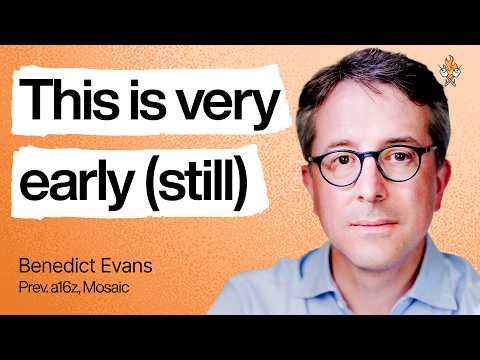
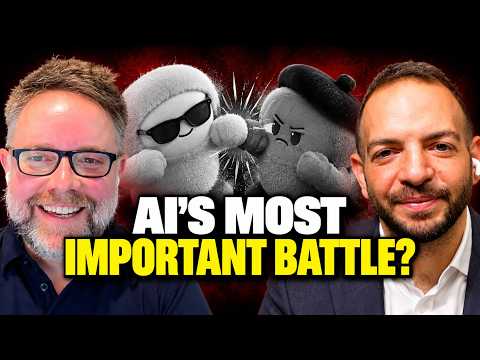
Benedict Evans offers a rare middle path on AI: it is absolutely enormous, on the scale of the internet or smartphones, but not a magical instant job apocalypse. His core message is both calming and demanding, we are early, we do not know who will capture the value, and the best response is not panic or denial but getting hands-on enough to understand what this technology actually changes.
AI is huge, but we are still in the 1997 fog
He opens with a line that sounds designed to irritate both hype people and skeptics: AI is "as big a deal as the internet or mobile and only as big a deal as the internet or mobile." That sounds minimizing until he flips the frame. Smartphones were a very big deal. The internet was a very big deal. The surprising point is not that AI is small, but that comparing it to the internet is already a claim of massive historical importance.
His real argument is about timing. If AI is the internet, then we are not in the polished, boring middle of the story. We are in 1997, the stage where everything is exciting, half the demos break, and most of the things people will eventually do have not been built yet. That helps explain the strange split in adoption. Inside tech, there are people who have bought a cluster of Mac minis and "don't use Google anymore." Outside tech, many regular users touch these tools every week or two, maybe. Even among younger users, he cites a rough pattern where only around 15 to 20 percent are daily active, another 20 percent are weekly, and the remaining 60 percent are not using them.
That uncertainty is not a bug in his worldview. It is the worldview. He jokes that a reaction to his 80-slide presentation was basically, "this is 80 slides are saying we don't know," and he thinks that is not entirely wrong. The same uncertainty applies to market structure. Asking today whether OpenAI or Anthropic has already won is like asking in the late 1990s whether the internet belonged to Excite or Yahoo. History suggests the eventual winners often come from a different angle than the one everyone is staring at early on.
When Lenny asks when life starts feeling radically different, Evans says software is already there. Developers are like accountants seeing the first spreadsheet. VisiCalc did not merely save time, it made people feel the ground shift beneath an entire profession. But for many other industries, AI still looks like an impressive demo in someone else’s department. A lawyer or journalist might look at it the way non-accountants looked at early spreadsheets, clever, useful, probably important, but not yet obviously central to my daily work. That gap between local wow and system-wide transformation becomes the thread for the rest of the conversation.
The hard part of work is usually not the part AI automates first
The conversation gets concrete when Evans explains why the hottest AI labs are hiring consultants and forward deployed engineers instead of replacing them. That sounds backwards until he points out how companies actually work. A large company does not have ten smart people sitting idle, waiting to redesign every workflow. If leadership wants to figure out which systems can be automated, which teams need retraining, and how three vertical systems should connect to two horizontal systems, that is not a chatbot prompt. It is a project. And projects are exactly why firms hire Bain, BCG, McKinsey, Accenture, architects, agencies, and specialists.
This leads to one of his most useful distinctions: the task is not the same as the job. A consultant does not get paid to generate a 75-slide deck. He mocks the AI demos that boast, "I made a McKinsey deck with Claude," then says what the client actually pays for is the walking around the company, understanding incentives, interviewing customers, and figuring out why the obvious solution has not already happened. The slides are just the receipt.
He reaches for several analogies to make this memorable. Amazon is excellent if you already know the SKU you want. If you know the exact microphone stand part number, great. But figuring out what product you need is a separate problem. In the same way, AI may be able to write code, but deciding what code should exist, for which customer, and how it reaches market remains a larger layer of work. He makes a similar point through history. Newspaper companies did not think of themselves as trucking and printing operations, but when the internet stripped away the physical distribution side, it exposed what part of the business was fragile. AI may unbundle industries too, but not always in the places people expect.
This is why he is skeptical of neat charts claiming a profession is exactly 17 percent automatable. Real jobs are not Lego sets with clean seams. They are bundles of judgment, social trust, sequencing, politics, and repetitive execution. Some tasks really do collapse into buttons, like an elevator attendant being replaced by the button itself. But often the cheaper a task becomes, the more demand expands elsewhere. His running joke is that people think Excel should have eliminated junior investment bankers, when in reality bankers still work brutal hours. The software removed toil, then the industry found new ways to consume the saved capacity.
Why the job apocalypse story is too simple, and why the model labs may not win
When Lenny raises fears about mass unemployment, Evans starts by pushing back on a subtle mistake: being good at building frontier models does not automatically make someone an authority on labor economics. He is interested in Dario Amodei’s views on what models can do in the next 6 to 12 months. He is less interested in treating any AI lab founder as the final word on comparative advantage, market structure, or how labor reconfigures after automation.
His broader point is classic economic history. Since around 1800, each major technology wave has removed visible jobs and created invisible future ones. You can always point to the typist, telephone operator, or typesetter and say, "that job is going away." You cannot as easily imagine the railway engineer before railways exist, because the new role sounds absurd until the new system is real. He does not deny the pain. Frictional dislocation is real. Towns get hollowed out. People lose livelihoods. But history says the process is usually not one giant replacement event. It is a long, uneven reorganization.
He is especially dismissive of the idea that companies will buy ChatGPT and fire everyone two weeks later. Big enterprises do not move like that. Sales cycles are measured in 18 months if you are lucky. Replacing a stack like SAP takes years. Even when a technology is ready, organizations need time to realize a problem can be solved a new way. He recalls companies started long before ChatGPT that could have existed years earlier, except nobody had yet recognized the opportunity clearly enough.
From there he turns to where the money will go, and his answer is much less flattering to foundation model companies than the current mood suggests. He doubts models have strong network effects. If several companies can supply broadly similar intelligence, and if users ultimately consume it through thousands of applications built by others, then the foundation models start to look less like Windows and more like cloud infrastructure or utilities. He quotes Sam Altman’s vision of selling AI like electricity, then points out that utility economics are not glamorous. Telecoms generate roughly a trillion dollars of revenue globally and spend around $200 billion a year on capex, yet mobile stocks have gone nowhere for decades because they are low-margin commodity infrastructure.
That unexpected angle reframes the entire AI gold rush. The most technically dazzling layer may not be the one that captures the best economics. If the models become necessary but interchangeable, then the real leverage may sit higher in the stack, in products, workflows, distribution, and default placement.
Distribution, backlash, and the messy politics around AI
Once you accept the possibility that models become commodities, another question gets sharper: who owns the customer? Evans says that if the product is undifferentiated enough, distribution becomes everything. He uses browsers as the cleanest historical parallel. A browser is basically an input box and an output box. The last major interface innovation, tabbed browsing, happened decades ago. So Microsoft won share by bundling, not by radically out-inventing everyone on user experience. Then, in a further twist, winning browsers did not matter nearly as much as expected because the real value ended up elsewhere.
He thinks something similar may happen in AI. Google can spray Gemini across every surface it controls. Meta can do the same with Llama-powered features, and ordinary users often do not care much about the nuanced differences that obsess power users. OpenAI’s scramble into "everything yesterday" starts to make sense in that light. If Google, Meta, Amazon, and eventually Apple can make AI the default layer on devices and services people already use, then having the best model may not be enough. The model may become the engine hidden under a more important product shell.
That product shell matters because the public conversation about AI is not one coherent objection. It is a pile of overlapping anxieties. Evans says anti-AI sentiment is a "big sort of fuzzy mess." Some claims are grounded. Some are culture war. Some are just wrong. He gives a striking example with water usage. Data centers do use water for cooling, but he looked up a Livermore Lab estimate that put total US data center water consumption at about 0.017 percent of US water use. That does not mean no local community can be harmed. A town with one well can still get angry for good reason. But it means national rhetoric can drift far from scale reality.
Jobs are messier. He says the data is surprisingly weak because the labs disclose little and economists are left reverse-engineering from labor surveys and consulting studies. There are suggestive signs, like weakness in employment for 18 to 24-year-olds, but not a clean consensus that AI is already driving a broad labor collapse. Meanwhile, there are narrower, emotionally loaded fights: illustrators losing cover art gigs, authors arguing about whether AI use is acceptable, and complaints about "AI slop" flooding media. The comparison to social media is telling. We are compressing a decade of backlash into a much shorter window, mixing valid concerns with persistent myths and half-truths.
His lesson is not that the backlash is irrational. It is that technologies always create new ways to damage people, deliberately or accidentally. The hard part is separating real harms from performative panic.
How to think about your career when nobody can map the whole future
The most useful personal advice comes late, after nearly an hour of refusing easy predictions. Asked what he would teach his children or recommend to anxious workers, Evans does not suddenly produce a master plan. He says if he had a 21-year-old entering the job market now, he would feel more immediate uncertainty than he does with a child in the early teens. For someone graduating soon, the rules are unstable. Five years from now, some of the dust may have settled, but in ways nobody can cleanly predict.
His practical framework is refreshingly ungrand. Careers already stopped being linear long before AI. He has been an equity analyst, operator, consultant, and independent thinker. The old model where you could know your profession for life has been fading for years. What matters more is finding the overlap between three circles: what skills you have, what jobs those skills make you good at, and what people will pay for. "You want to get at least two of those and preferably all three."
On the deeper AI question, he says people are still not asking enough about what really changes when a technology stops doing "the old thing but more" and starts enabling an entirely new category. He uses recorded music to illustrate this. The first part of the industry’s collapse was about no longer paying $15 for a CD to hear a track. The second part, driven by streaming, asked a completely different question: what happens when $15 a month gives you all the music there is? That is not just the old business online. It is a reframing of the entire value proposition. The big AI companies of the future may come from similarly weird redefinitions that sound wrong until they suddenly seem obvious, the way Uber, Airbnb, or Spotify once did.
He is openly contemptuous of tidy exposure scores that rank jobs by automatable percentages. Those models miss second-order effects. In 1997, nobody would have said the internet was coming for taxi drivers. Yet Uber transformed taxis without automating driving. By the same logic, claims that jobs like personal training are insulated may miss how AI changes the surrounding workflow. Put a phone on gym equipment, ask an AI to build the routine, and let it correct your form. Maybe that is nonsense, maybe not. The point is that exposure often arrives sideways.
So what should people do now? His answer is blunt: do not stick your head in the sand. Refusing AI may feel morally satisfying, but it will not make you more employable. Dive in, immerse yourself, and come out understanding what it can do today, where it fails, and how it might change the profession you want. It is not a guarantee. But in a world where firms may hire 50 associates instead of 100, showing up saying you will never use AI is about the worst possible opening move.
The final mood: humility, curiosity, and 'it'll probably be okay'
In the closing stretch, Evans becomes almost comically honest about how he uses AI himself. For his own work, which depends on precise information retrieval and synthesis, he says the things he most wants a machine to do are the things current AI is often worst at. He uses it for proofreading, for image editing, and even for redecorating his apartment, taking a photo of a room and asking the model to repaint it, change the rug, add a table, add a light. That worked "fantastically well." He also notes that much of what now feels ordinary may already be AI in disguise. He dictates a lot of his writing into voice notes and relies on transcription. Is that AI, or has it already dissolved into "just automation"?
That dissolving effect is part of his larger point about terminology. AI keeps getting defined as whatever machines cannot do yet. Once they can do it, people relabel it as software, machine learning, automation, or just a feature. The same skepticism extends to grand terms like AGI and superintelligence. We do not have a theory of human intelligence, he says. We do not really know why these models work as well as they do, nor how much better they will get. So a lot of the public debate becomes what he calls vibes forecasting, plus a lot of creative redefinition of terms.
What stands out most by the end is not a forecast but a temperament. He returns repeatedly to historical perspective. Every technological wave introduces new forms of harm. He gives the chilling example of the UK Post Office scandal, where buggy Fujitsu software falsely showed cash shortfalls, leading to prosecutions, bankruptcies, suicides, and ruined lives. That story matters because it was not science fiction. It was ordinary computerization. Every generation gets new tools for efficiency and new tools for injustice.
And still, his default stance is not panic. Asked for a life motto, he lands on a phrase that quietly summarizes the entire interview: "It'll probably be okay." Not certainly. Not universally. Not immediately for everyone. But probably. That small word matters, because it preserves both optimism and moral seriousness. The future is not prewritten. It depends. And that is exactly why understanding the tools matters so much.
Keep these ideas with you.
- We are in AI's 1997 moment
Evans' most memorable framing is that AI is like the internet in 1997. Everyone can feel something big is happening, but most products are early, many use cases have not been invented, and the eventual winners are probably not obvious yet. That framing is useful because it cuts against both extremes: AI is not a toy, and it is not a finished destiny.
- The task is not the job
A chatbot can make a rough PowerPoint, but that is not why companies hire McKinsey. They hire for diagnosis, politics, customer interviews, sequencing, and judgment. AI often attacks the visible output first, while the real economic value sits in everything around that output.
- Automation often creates sideways change, not clean replacement
In 1997, almost nobody would have said the internet threatened taxi drivers. Yet Uber transformed the taxi market without automating the act of driving. The lesson is that jobs rarely disappear only through direct substitution. They also get reshaped by new coordination layers, new expectations, and new business models.
- Foundation models may become utilities
Sam Altman says AI could be sold like electricity, and Evans replies that utility economics are not exactly a dream business. Telecom networks and cloud infrastructure are technically miraculous, capital intensive, and often low margin because the value gets captured higher in the stack. If models become necessary but interchangeable, the big money may go to products, workflows, and distribution instead.
- Do not confuse moral posture with career preparation
Evans is blunt that publicly hating AI may feel satisfying, but it does not help you navigate a changing labor market. If a law firm is hiring 50 associates instead of 100, showing up proud that you never use AI is unlikely to impress anyone. Hands-on familiarity may not guarantee safety, but avoidance almost certainly weakens your position.
- Every technology wave creates new ways to hurt people
The UK Post Office scandal is his warning against naive techno-optimism. Ordinary software bugs falsely accused hundreds of franchise operators of theft, leading to prison, bankruptcy, and suicide. The point is not that AI is uniquely dangerous, but that every new system expands both capability and the surface area for human damage.
Turn the ideas into action.
For Career Resilience
Immerse yourself in AI tools now, especially the ones touching your field. The goal is not to become a maximalist believer, but to understand where the systems are genuinely useful, where they fail, and how to talk about them intelligently in hiring and promotion conversations.
For Product Strategy
Build for workflow and distribution, not just raw model access. If foundation models become increasingly interchangeable, the durable advantage will come from owning the user relationship, fitting into a real job to be done, and making the product the default way work gets done.
For Evaluating AI Risk
Separate local harms from inflated narratives by checking scale and mechanism. Evans' water example matters because it shows how a real local planning issue can become a misleading national story if nobody looks at the denominator.
For Understanding Job Impact
Ask what part of a profession is the task and what part is the job. This helps you avoid shallow conclusions like "AI can write decks, therefore consulting dies" and instead identify the parts of work that are likely to expand, compress, or move into adjacent roles.
For Long-Term Opportunity Finding
Look for products that do more than make the old process cheaper. The biggest companies often emerge when a technology reframes the whole question, the way streaming changed music from buying tracks to getting access to all music for a monthly fee.
The complete summary: 6 chapters, 6 takeaways and 5 actionable insights.
Summarised with AI by Bite, an AI YouTube video summarizer and podcast summarizer. Timestamps keep the source close; check important details against the original.
Original video on YouTube