Y Combinator
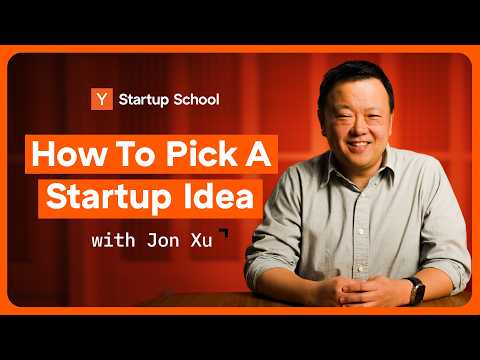
How To Pick A Startup Idea
Summarised with Bite · 11 min read
John from YC gives founders a blunt antidote to startup idea paralysis: stop hunting for the perfect idea in your head, pick one, and get reality to answer the question for you. The core lesson is that depth creates signal, and signal is what lets you discover whether your first idea works, or whether the better company is hiding underneath it.
0:33 – 2:34
The Trap of Waiting for the Perfect Idea
A founder sits with five promising ideas open in ten tabs, convinced that one more week of thinking will reveal the winner. John’s argument is that this instinct feels rational, but it quietly kills progress. At [0:33], he says the hardest part is not generating options, it is committing long enough to get meaningful feedback. A startup is too tied to messy reality for you to solve it like a thought experiment. He names two common forms of overthinking. The first is the search for the perfect idea. It sounds disciplined, but his point at [1:03] is that perfection cannot be discovered in the abstract. You only learn what is worth building by talking to customers and seeing what breaks in the real world. The second is the founder asking, "Am I the perfect founder for this?" John agrees that founder market fit matters, but he pushes back on the way people use it against themselves. At [1:33], he says founders often act as if they need "a decade of domain experience" before they are allowed to begin. His unexpected angle is that deep curiosity plus speed can substitute for pedigree. He argues that if you pick something you genuinely want to understand, go extremely deep, and keep talking to customers, you can build extraordinary knowledge quickly. To make that believable, he uses Blake Scholl from Boom Supersonic at [2:03]. Blake had worked in adtech at Amazon and Groupon, then decided to commercialize supersonic flight, a jump that looked absurd from the outside. Yet Boom became a billion-dollar company. The story is not just motivational. It is evidence for John’s deeper claim: permission is usually self-imposed. The bigger risk is not being underqualified. It is staying stuck in analysis long enough that you never get the one thing startups need most, contact with reality.
4 more sections in the app
- 2:34 – 4:36Burn the Other Boats and Become Someone New
- 4:36 – 6:08Know the Customer Well Enough to Run Their Business
- 6:08 – 9:14What Good AI Startup Ideas Look Like Now
- 9:14 – 11:18The Real Goal Is Not Validation, It Is Discovery
Summarised by Bite, an AI YouTube video summarizer that also works as a podcast summarizer.