Artificially Aware
Why People Can't Stop Performing
Summarised with Bite · 11 min read
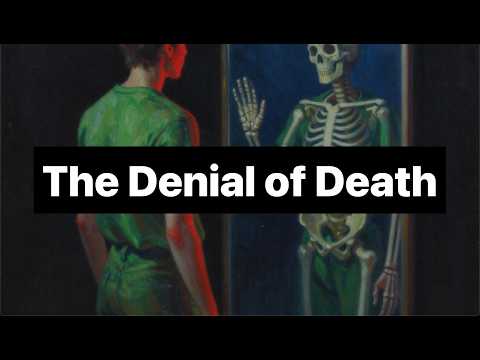
This video uses Ernest Becker's The Denial of Death to answer a disturbing question: why do people keep performing, obeying, comparing, and clinging to status even when it makes them miserable? Its answer is that personality, culture, ambition, romance, and even political devotion often function as defenses against death anxiety, and once you see that machinery, you can start choosing your hero system more consciously instead of being run by it.
0:02 – 15:27
The personality as a survival costume
A beauty queen walks into a Los Angeles restaurant to meet Frank Sinatra, already medicated with five aspirins and loosened up by a massage, and still her hands go numb the moment she sees him. She says he had "like a halo around his head of stars" and admits, "When I'm with him, I'm in awe, and I don't know why I can't snap out of it. I can't think." The video opens there because that moment is not treated as celebrity gossip. It is treated as a diagnosis. The claim is that this kind of collapse happens because adults do not stop looking for all-powerful figures, they just disguise the need better. From there, the argument drops into Becker's central idea from The Denial of Death. What we call personality is not simply self-expression. It is a defensive structure built in childhood after a person realizes, sometime between ages 3 and 10, that they and everyone else will die. That realization is too large to carry directly, so the child constructs what Becker calls the vital lie, a practical fiction that makes daily life bearable. The video makes this memorable with a physical metaphor: character is built the way a body builds a scab, automatically and urgently, over a wound that never truly closes. Freud's transference, Zilborg's clinical writing on ever-present death fear, and William James's line that "the skull will grin in at the banquet" all get folded into the same architecture. Death terror is described not as a rare panic, but as background wiring that powers ordinary life while staying out of sight. The child first tries to solve this terror through the body and through magical control. That is why the Oedipus complex is reframed here, not as a sexual melodrama, but as the Oedipal project, the attempt to become the parent of oneself, the cause of one's own existence. It is a doomed attempt to turn vulnerability into godhood. When that bodily fantasy fails, culture takes over. The child submits to social roles, inherited meanings, and approved forms of heroism. That transition is what most people call maturity. Becker calls it a trade, giving up a childish impossibility for an adult one. The adult now becomes, in Maslow's phrase, both worm and god: a creature capable of contemplating infinity while trapped in a leaking, decaying body. The video drives this home with grotesque, unforgettable images, Jonathan Swift's horror that "Celia shits," the Chaga men who wore anal plugs, and the claim that modern image-curation is simply a cleaner-looking version of the same denial. The point is unsettling and concrete. Civilization is not the opposite of animal fear. It is one of the ways fear dresses itself.
2 more sections in the app
- 15:59 – 25:58Culture, leaders, and love as immortality machines
- 26:29 – 42:08When the lie cracks, and how to choose one anyway