RealLifeLore
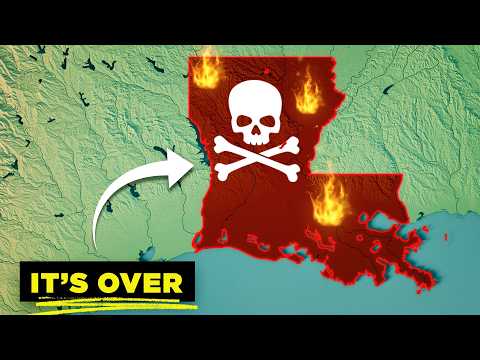
Why Louisiana is America's Fastest Dying State
Summarised with Bite · 34 min read
Louisiana sits atop the Mississippi River Delta controlling 41% of America's inland waterways, dominates oil refining and LNG exports, and boasts more port tonnage than Texas. Yet it ranks dead last in quality of life, loses a football field of coastline every 100 minutes, and could see New Orleans become an exposed island or vanish entirely by 2070 due to sinking land and rising seas exacerbated by a century of policy favoring corporations over residents.
0:00 – 5:09
The Geographic Jackpot Louisiana Should Have Won
By every measure of geography and resources, Louisiana should be among America's wealthiest states. The Mississippi River drains 41% of the entire United States, creating the largest continuous network of navigable inland waterways on Earth. River barges can travel from Minneapolis, Omaha, Kansas City, Nashville, Louisville, Cincinnati, and Pittsburgh all the way to the Gulf of Mexico through Louisiana's delta. Whoever controlled this delta controlled access to an entire continent's worth of river trade. New Orleans was built as close to the mouth as physically possible to capitalize on this advantage. The city became a critical transfer point where riverborn cargo switched to oceanbound ships and vice versa. By 1840, New Orleans was the third largest city in the entire country. It remained the largest city in the American South until Houston surpassed it in the 1950s. The advantages don't stop there. Louisiana sits on a massive salt deposit, making it the number one or two salt producer in the country. It's the third largest rice producer and second largest sugar cane producer. The state hosts the second largest oil refinery capacity in America at 3.3 million barrels per day. Nearly one in every five barrels of oil refined in the US happens in Louisiana. The state is a top ten crude oil producer and top three natural gas producer, generating roughly 10% of all American natural gas. Louisiana completely dominates America's liquefied natural gas export capacity. Two thirds of all American LNG exports flow through Louisiana terminals like Sabine Pass, Calcasieu Pass, Cameron LNG, and Plaquemines LNG. A small town called Erath hosts the Henry Hub, where 11 interstate pipelines converge. This junction point sets the price of natural gas for the entire North American market and serves as the starting point for global LNG pricing formulas. Since 2024, these pipelines have helped make the United States the world's largest LNG exporter, a critical component of American geopolitical power. Along an 85 mile stretch of the Mississippi River between New Orleans and Baton Rouge sits what's generously called the Silicon Valley of petrochemicals. More than 150 petrochemical plants account for nearly 25% of all petrochemical production in America, producing roughly $80 billion in output annually. This is the largest concentration of refineries and petrochemical plants anywhere in the Western Hemisphere. Huge foreign investments in these industries have made Louisiana one of the top three per capita recipients of foreign direct investment in the US since 2008. Louisiana's ports reflect all these advantages. The state has by far the largest total port tonnage of any American state. Five of America's top 15 busiest ports by tonnage are in Louisiana, including the second and sixth busiest at the Port of South Louisiana and Port of New Orleans. Louisiana handles more port tonnage than Texas and more than double California's tonnage. The state's GDP per capita sits at $74,000, higher than Sweden's. On paper, Louisiana should be thriving.
8 more sections in the app
- 5:09 – 8:18The Paradox: Why Prosperity Never Arrived
- 8:18 – 13:33The Corporate Giveaway Machine
- 13:33 – 17:59The Failed Reform and Cancer Alley
- 17:59 – 21:50A State Built on Corruption
- 21:50 – 26:02The Living River That Wants to Move
- 26:02 – 30:19Engineering Against Nature and the Accelerating Crisis
- 30:19 – 34:07The Unique Doom of Sinking While the Sea Rises
- 34:07 – 37:59The Terminal Diagnosis and Abandonment of Hope
Summarised by Bite, an AI YouTube video summarizer that also works as a podcast summarizer.