Wheeler Avenue Faith Power
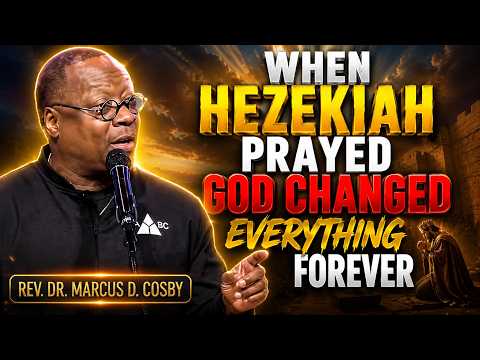
WHEN HEZEKIAH PRAYED | God Still Hears, Heals, and Adds Years | Rev. Dr. Marcus D. Cosby
Summarised with Bite · 12 min read
This sermon uses King Hezekiah's crisis in Isaiah 38 to answer a painful question: what do you do when bad news comes from a God you still trust? Rev. Dr. Marcus D. Cosby argues that God still hears prayer, sees tears, remembers faithful living, and can turn lament into celebration, making this message both a theology of suffering and a practical guide for how to pray when life feels unfair.
0:00 – 10:59
When the bad news lands, turn to the wall
The sermon opens in a room already charged with hope. Before he ever explains the text, Cosby asks for people who have been healed and are not ashamed to say so. That is not just crowd work. It sets the stage for a story about a man who did everything right and still got devastating news. Cosby introduces Hezekiah as no minor Bible character, but a "heavyweight" of the Old Testament, the 13th king of Judah, son of Ahaz. He lingers on one striking detail: Hezekiah came from a flawed father, yet did not have to repeat that legacy. "You ain't got to be like your daddy if your daddy was no good." That line turns biography into application. Hezekiah becomes proof that inherited patterns are not final. From there, Cosby sketches a king who trusted God, defeated the Assyrians, led faithfully, and was described in 2 Kings 18 with almost unmatched praise: "There was no one like him among all the kings of Judah either before him or after him." Then the emotional floor drops. Into the life of this good and godly man comes Isaiah with a sentence nobody wants to hear: "Get your house in order, for you're going to die and you will not recover." Cosby does not rush past the shock. He slows down to ask what many listeners are secretly asking about their own lives. What do you do when the worst news arrives? What happens when life is "lifing" in a way you never anticipated? He refuses fake spirituality here. God is good, he says, but the diagnosis is not good. Christians do not have to pretend painful things feel fine. That tension creates the sermon's first major turn. Between the announcement and the response, Hezekiah has to decide what kind of person he will be under pressure. Pity party, bitterness, regret, spiritual collapse, all those options are sitting there. But the Bible says, "Hezekiah turned his face to the wall and prayed to the Lord." Cosby makes that gesture vivid. Turning to the wall means shutting out the noise, the yapping voices, the distractions, and choosing to talk to God. The unexpected angle is that the wall is not retreat. It is focus. In a moment where everything is slipping, prayer becomes the one deliberate act of agency Hezekiah still has.
3 more sections in the app
- 11:02 – 25:26The prayers nobody sees and the life God remembers
- 26:07 – 38:30Before Isaiah leaves the palace, God turns it around
- 39:12 – 1:03:11From sermon to altar, from individual pain to shared faith
Summarised by Bite, an AI YouTube video summarizer that also works as a podcast summarizer.