Business Insider
What 'Made In America' Jeans Actually Look Like
Summarised with Bite · 13 min read
This video asks a simple question with a complicated answer: if almost all jeans sold in the US are made overseas, what does "Made in America" actually mean now, and can it still matter? By comparing a giant Pakistani one-stop factory with one of the last major American denim mills, it shows that US mills cannot win on cheap labor or scale, so they are trying to survive by selling quality, technical performance, craft, and history.
0:00 – 2:37
From American icon to imported default
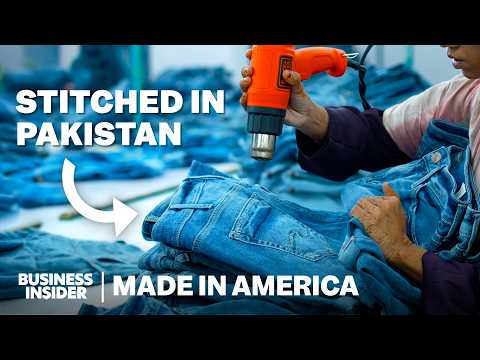
The video opens inside a massive denim operation producing 1.4 million pairs of jeans a month, a scale that immediately makes the central tension feel real. More than 90% of denim clothing worn in the US today is made abroad, even though jeans once stood for America itself. In the early 1900s, the US produced over a third of the world's denim, and by the 1960s, 95% of clothing Americans wore was made in the US. Today that number is just 2%. The story starts much earlier, in 17th century France. Denim comes from de Nîmes, literally "from Nîmes." The trick that made the fabric practical was also what gave it its famous look: only half the yarn was dyed, with blue yarn running one way and white crossing it. That made it cheaper while keeping it sturdy, which is why it caught on as hard-wearing workwear in Europe and the US. But denim was not yet jeans. That changed in 1873, when Levi Strauss patented pants reinforced with copper rivets. Those jeans were built for people who broke things for a living, farmers, mechanics, gold miners, lumberjacks. Later, Hollywood helped flip the meaning. James Dean and Marlon Brando turned work pants into a symbol of cool, and by the 1960s jeans also carried the energy of counterculture and rebellion. That is the unexpected angle running through the whole video: a garment born from thrift and toughness has become a global fashion product, often disconnected from the industrial base that first made it famous. So the real question is not just where jeans come from. It is whether consumers still value the story behind them enough to support a much more expensive way of making them.
4 more sections in the app
- 2:37 – 4:09What American mills are really competing against
- 4:09 – 8:14Mount Vernon's survival plan, cleaner processes, faster machines, fewer workers
- 8:14 – 12:25Why premium denim, technical denim, and old looms might save a US mill
- 12:25 – 14:05Do shoppers care enough to pay for Made in America
Summarised by Bite, an AI YouTube video summarizer that also works as a podcast summarizer.