Teddy Baldassarre
What $2,000 Buys You in 2026
Summarised with Bite · 12 min read
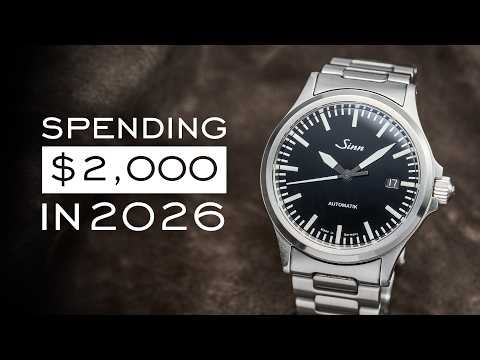
This is a guided tour of the watch market's most awkward but surprisingly rich tier: around $2,000 in 2026. The host argues that while many big brands have drifted upward, this price point has become a sweet spot for smart buyers because it now mixes mainstream Swiss value, serious German watchmaking, and a wave of independents and microbrands doing unusually interesting work.
0:00 – 8:10
Why the forgotten $2,000 tier still matters, and the mainstream standouts that prove it
The video opens by attacking a quiet assumption: that $2,000 has become a dead zone in watches. The host admits it can feel like a strange bracket because so many brands have either moved below it for entry pieces or above it for anything ambitious. But that is exactly why this category is worth revisiting. He sets a practical range of $1,750 to $2,250, wider than usual, because the best candidates now sit a little above or below the number rather than landing neatly on it. The first big proof point is Longines, and the message is simple: when competitors vacate a price tier, a brand with timing and discipline can dominate it. The HydroConquest update becomes the flagship example. The newer version strips out the oversized Arabic numerals of the older design and replaces them with a cleaner lacquered dial and subtler markers. It still keeps the hard specs buyers expect, 300 meters of water resistance, a ceramic bezel, and the caliber L888.5 with 72 hours of power reserve. The key surprise is that this is not presented as a wildly original watch. The host practically says that is the point. It is "very down the middle in terms of its appeal," yet that exact balance, plus a $2,200 price on bracelet and on the fly micro adjustment, makes it one of the year's biggest hits. Longines gets a second slot with the Flagship Heritage, and this is where the category opens up beyond pure sport watches. Instead of a modern diver, this one reaches back to 1957 and leans fully into dressy vintage charm: black dial with rose gold accents, or ivory with yellow gold tone hands, a small seconds display, and a date at six. The standout detail is hidden, an 18 karat gold flagship medallion with blue hand enamel on the caseback, which the host treats as a level of embellishment you do not expect here. Together, the two Longines models make an argument that $2,000 can still buy either mass appeal competence or old world character. From there the section broadens into recognizable enthusiast names. Doxa's SUB 300T keeps the brand's trademark orange dial, no decompression bezel, and a massive 1,200 meters of water resistance, all for just under $2,200 on bracelet. Nomos takes the discussion in a totally different direction. The Club, in 36 mm and 38.5 mm sizes, brings 100 meters of water resistance and, more importantly, a quiet upgrade from the old Alpha manual movement to the DUW 4101 at just 2.6 mm thick, with 53 hours of power reserve and the in house Swing System escapement. The host calls it maybe the most in house made watch on the list, which is the kind of statement that reframes the whole price tier. Oris then rounds out the sequence with the Big Crown Pointer Date, a watch dating back to 1938 that still feels distinctive because almost nobody at this price does the pointer date complication with this much personality.
2 more sections in the app
- 8:10 – 17:19Where the value gets more interesting: independents, tool watches, and overlooked specialists
- 17:19 – 25:33The indie takeover, and why the best reasons to shop this tier may be outside the biggest brands
Summarised by Bite, an AI YouTube video summarizer that also works as a podcast summarizer.