Sabine Hossenfelder
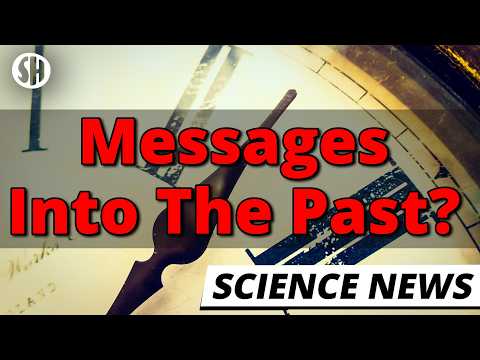
These Physicists Claim They Can Send Messages To The Past
Summarised with Bite · 7 min read
MIT physicists published a paper in Physical Review Letters claiming a theoretical method to send messages backward in time using quantum mechanics and postselection. The catch? It's indistinguishable from making very good predictions, and the technique only works if you assume the universe cooperates by delivering the exact outcome you need.
0:00 – 3:33
The Quantum Loophole That Might (or Might Not) Break Time
Imagine sitting in front of a screen watching static flicker across it for hours. Suddenly, two words appear: "BUY NVIDIA." You follow the advice, and a year later you're wealthy. Did you receive a message from the future, or did your machine just get lucky with a prediction? According to a new paper from MIT researchers published in Physical Review Letters, there's no way to tell the difference, and that's exactly the point. The paper builds on quantum mechanics' uncomfortable relationship with causality. Once you accept that particles can exist in multiple states simultaneously, and Einstein has already told us there's no objective way to determine what happens "at the same time," quantum mechanics takes the next logical step: you also can't always tell what happened in which order. Causality itself becomes uncertain, just like everything else in quantum physics. The MIT team's setup works like this: You build a receiver device at some point in time, and only after you build it can you receive messages. Before that moment, no messages are possible. You prepare a special quantum state and let it evolve. Later, a sender measures this quantum state, and that measurement supposedly injects information backward into your receiver in the past. The new paper's contribution is showing this communication channel still functions even when noise is present, and surprisingly, noise causes fewer problems when sending messages backward than forward. The mechanism relies on something called "postselection," which means you only look at specific outcomes after measuring the quantum state. In standard quantum physics, you can't predict which outcome you'll get. But the researchers postulate that we live in a universe with only one outcome, and the message you receive in the past is simply whichever outcome will actually happen. It's a clever theoretical trick, but it requires the universe to cooperate in a very specific way.
2 more sections in the app
- 3:33 – 4:57The Prediction Problem (and Why It Matters)
- 4:57 – 6:02Rethinking Time Itself
Summarised by Bite, an AI YouTube video summarizer that also works as a podcast summarizer.