Casual Finance
The World's Safest Market Is Breaking
Summarised with Bite · 10 min read
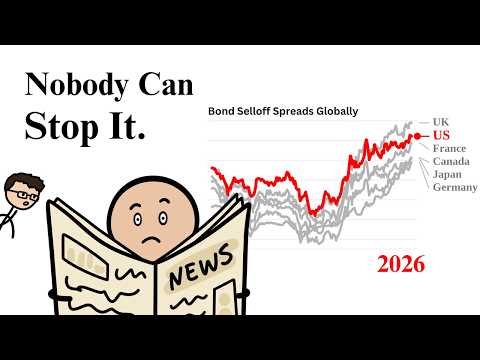
This video argues that the recent jump in long-term government bond yields across the US, Germany, the UK, France, Canada, and Japan is not mainly a debt panic about one country. It is a global buyer problem: the old institutions that used to buy long bonds almost regardless of price, especially defined benefit pension funds, are fading away, leaving governments to refinance trillions in debt with much more price-sensitive investors.
0:00 – 5:43
The invisible buyer that used to hold the whole system up
Six countries get hit in the same week, and that is the first clue that the usual explanation is too small. America’s 30-year yield hits its highest level since 2007. Germany’s reaches a level not seen since 2011. The UK goes back to 1998, France to 2008, Canada to 2010, and Japan touches an all-time high. If this were just a story about one reckless government borrowing too much, Germany should not be in the lineup. It is the fiscal conservative of the group, carrying the lightest debt load among the G7, yet its long rates surge too. That is the curiosity gap the video opens: if debt alone cannot explain it, what can? The answer starts with a paper mill and a worker named Dwight. The company promised him $2,000 a month for life after retirement. That promise has a shape: fixed cash payments, on a fixed schedule, stretching decades into the future. Stocks are no good for that. They might build wealth over time, but they do not guarantee Dwight’s check arrives on the first of every month. So the employer buys the most boring asset possible, a 30-year government bond, because the bond’s cash flows can be lined up against the pension payments. Once that bond is in the portfolio, its market price barely matters. The owner is not trading it, not trying to time rates, not worrying about whether the Fed chair sounded nervous. The coupons will arrive, the principal will come back at maturity, and Dwight gets paid. That made defined benefit pension funds a very unusual kind of buyer. They had deep pockets, legal obligations, and almost no interest in day-to-day price swings. For decades they were the ideal customer for the long end of the bond market. Then that customer started disappearing. In 1985, 80% of full-time workers at medium and large American companies were in a defined benefit plan. By 2000, that was 36%. Today it is around 14%. They were not destroyed in a crash. They were replaced quietly by 401ks, one HR decision at a time. And that tiny-looking administrative change completely altered bond demand. Under a 401k, the company owes nothing beyond payday, and the worker chooses the investments. More than 70% of 401k assets sit in stocks, while standalone bond funds get about 5%. In plain English, the biggest structural bid for long government bonds in the last half century has been fading out.
2 more sections in the app
- 5:43 – 9:19How pensions stopped being forced buyers, from Britain to the Netherlands
- 9:19 – 16:36The global shortcut to short-term debt, and why it makes the trap worse
Summarised by Bite, an AI YouTube video summarizer that also works as a podcast summarizer.