UnHerd
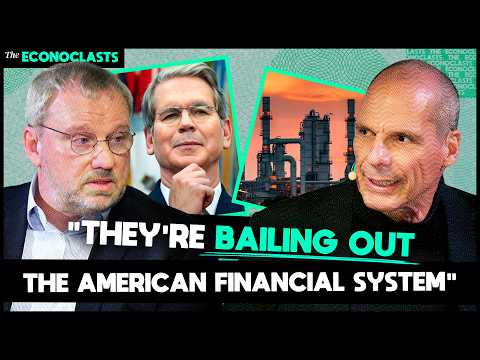
The US is quietly bailing itself out - Yanis Varoufakis & Wolfgang Munchau | The Econoclasts
Summarised with Bite · 6 min read
Yanis Varoufakis and Wolfgang Münchau dissect the Iran conflict as more than a Middle East war—it's a financial stress test exposing cracks in dollar hegemony. They argue the U.S. isn't bailing out Gulf states with swap lines; it's bailing out itself as petrodollar recycling breaks down, threatening the $6 trillion system that funds American deficits and military spending.
0:00 – 6:00
The Swap Line Paradox: When a Bailout Flows Backward
Varoufakis opens with a provocation: the swap lines Treasury Secretary Scott Bessent offered to the UAE and Saudi Arabia aren't charity—they're self-rescue. The orthodox reading sees Washington helping Gulf states whose oil revenues collapsed during the Iran blockade. But the UAE holds $2 trillion in assets, ten times the U.S. exchange stabilization fund's capacity. Why would they need $20 billion? The answer lies in what happens when petrodollar recycling stops. Since the 1970s, Gulf states earned trillions selling oil, then funneled that cash back into U.S. Treasuries, military contracts, and real estate—the lifeblood of American deficits running at 8% of GDP. Now that flow is choking. Saudi Arabia's promised $1.4 trillion for semiconductors and AI, plus $1 trillion in weapons purchases, sits frozen. Varoufakis argues Bessent—a former hedge fund manager who once shorted the Bank of England—knows poachers smell blood when $2.5 trillion vanishes from Treasury demand. The swap line, though laughably small, signals the Fed may step in with unlimited firepower once Trump's new Fed chair arrives. Münchau agrees it's strange but sees broader fears: a collapse of the dollar payment system itself, especially if Iran destroys undersea internet cables in the Persian Gulf, severing banking infrastructure. The swap line isn't fixing anything—it's calming markets with the promise of future action, buying time before panic sets in.
2 more sections in the app
- 6:00 – 18:00The Diplomacy That Isn't: Why the War Won't End Soon
- 18:00 – 35:17Electrification, Fragmentation, and the End of the Petrodollar Era
Summarised by Bite, an AI YouTube video summarizer that also works as a podcast summarizer.