Numberphile
The Unsolved Lollipop Problem - Numberphile
Summarised with Bite · 5 min read
A mathematician draws circles and sticks on paper, trying to slice the page into as many regions as possible. The problem looks childish until you realize no one knows the answer beyond four lollipops, and proving the five-lollipop case might require reinventing geometry itself.
0:00 – 6:13
A Circle on a Stick Becomes a Puzzle
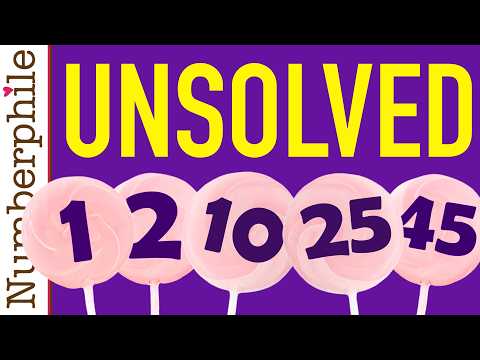
Picture a circle with a line jutting out perpendicular to its edge, like a pin through a balloon. Extend that line to infinity in both directions, and you have what mathematicians call a lollipop. One lollipop carves the plane into two regions: inside the circle and everywhere else. Now add a second lollipop. If you position them carelessly, you get seven regions (the interviewer catches this immediately when the mathematician undercounts). But arrange them with precision, overlapping the circles in a sliver and threading each stick through the other's circle, and suddenly you have 10 regions. The difference comes down to intersections: where circles cross circles, where sticks pierce circles, and where sticks meet sticks. Each new crossing births new regions. The formula is deceptively simple: regions equal intersections plus the number of lollipops plus one. With two lollipops crossing at seven points (two circle-circle, two stick-circle each way, one stick-stick), you get 7 + 2 + 1 = 10. The pattern holds for three lollipops too: arrange them so each pair crosses at seven points (21 total intersections), and you get 21 + 3 + 1 = 25 regions. The drawing looks like a tangle of surgical incisions, each stick carefully offset so no three lines meet at a single point, because triple intersections waste potential regions.
2 more sections in the app
- 6:13 – 12:29The Fourth Lollipop Breaks the Pattern
- 12:29 – 13:37Five Lollipops and the Edge of Knowledge
Summarised by Bite, an AI YouTube video summarizer that also works as a podcast summarizer.