The Action Lab
The Strange Physics Behind the Oberth Effect
Summarised with Bite · 8 min read
A spring-loaded rocket that stores only 300 mJ of energy somehow gains over 400 mJ of kinetic energy when launched while already moving. This isn't free energy, it's the Oberth effect: one of the most powerful phenomena in space travel that lets you extract vastly more energy from the same fuel burn simply by firing your rockets at the right moment.
0:00 – 1:30
The Impossible Energy Gain
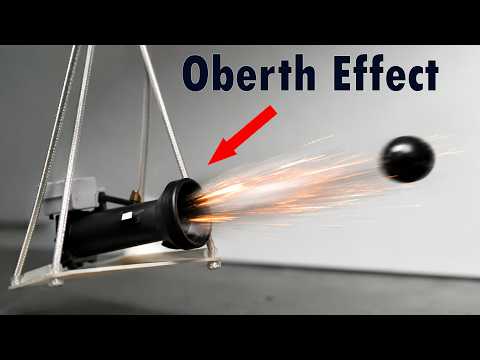
The host stands with a spring-powered ball launcher, a tiny rocket with exactly 300 millijoules of stored energy. He poses a deceptively simple question: does firing this rocket while it's already moving give it more kinetic energy than firing it from rest? Intuitively, the answer should be no. Motion is relative, so moving at constant velocity should be indistinguishable from standing still. But when he runs the experiment, the numbers defy expectation. Launching from rest, the rocket gains only 31 mJ of kinetic energy. Launching while already moving at 2.5 meters per second, the rocket gains 425 mJ, more than the spring actually contains. This feels like creating energy from nothing, which should be impossible. Yet this isn't a parlor trick or measurement error. It's a real phenomenon called the Oberth effect, and understanding where this "extra" energy comes from reveals one of the most powerful principles in spaceflight.
4 more sections in the app
- 1:30 – 3:34Building a Controlled Rocket Experiment
- 3:34 – 6:41The Mystery of Vanishing and Multiplying Energy
- 6:41 – 8:13Why the Oberth Effect Is Unlimited in Power
- 8:13 – 9:15The Key to Reaching Other Stars
Summarised by Bite, an AI YouTube video summarizer that also works as a podcast summarizer.