Andrew Huberman
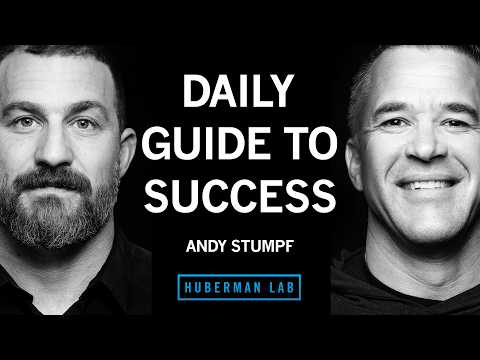
The Mental Frame & Specific Daily Actions to Succeed | Andy Stumpf
Summarised with Bite · 19 min read
This conversation starts with a deceptively small idea, choose the slightly harder option more often, and then keeps proving how much of life hangs on that habit. Andy Stumpf and Andrew Huberman move from a two-column paper exercise to social media addiction, wingsuit flying, divorce, fatherhood, pain, and suicide, all circling the same question: how do you keep your mind pointed at what you can actually do when life gets loud, chaotic, or crushing?
4:39 – 14:59
The paper that shrinks chaos
At [4:39], Huberman says he was on time for the first time in his life, and he credits a one-page exercise from Andy's book. That is the hook for the first big idea: draw a line down a piece of paper, write concern on the left and influence on the right, then list what is occupying your waking hours. Andy says the result is almost always startling. The left side, your concerns, spreads as wide as "the size of this table." The right side, your influence, shrinks to something like "the size of a pin drop." The unexpected turn is that the right side is usually not your boss, your kids, the news, politics, or even the people you love. It is mostly you. Your thought process, the way you speak to yourself, the way you plan your day, the way you manage your time. Andy's conclusion is blunt: "I have no control over what happens to me in my life but I have absolute and complete and total control over how I respond to it." That is why Huberman says the exercise gave him a greater sense of agency. It did not remove stress. It separated useful stress from useless mental noise. Then the conversation takes a modern turn. Social media, they argue, massively expands the left column. Huberman describes how social platforms let your past, your peers, strangers, and global events all live in your mind at once. Andy gives a practical experiment instead of a moral lecture. In January, he and former SEAL Chad Wright tried to cut phone screen time to under an hour per day. Chad got down to about 90 minutes. Andy got his down to 30 minutes the last week, mostly by forcing his social media use onto a laptop, where Instagram "sucks" and is too clunky to keep scrolling. His verdict is memorable: his mental health in January was better than it had been in a long time. That leads to one of the strongest ideas in the episode. The platforms are powerful, but participation is still optional. Andy's test question is simple: is the platform working for me, or am I working for it? That is the concern versus influence exercise in disguise. If a tool is hijacking your attention, it has crossed from your right column into your left, and you need to reclaim the border.
5 more sections in the app
- 36:10 – 1:02:55Why danger felt like peace
- 1:03:09 – 1:14:29The hardest thing was not combat
- 1:31:06 – 1:47:30Toilet paper, tiny discipline, and the architecture of a life
- 2:03:19 – 2:24:43Pain, suicide, and the danger of a distorted self-image
- 2:37:11 – 2:52:22Enough, uncertainty, and the version of success worth having
Summarised by Bite, an AI YouTube video summarizer that also works as a podcast summarizer.