20VC with Harry Stebbings
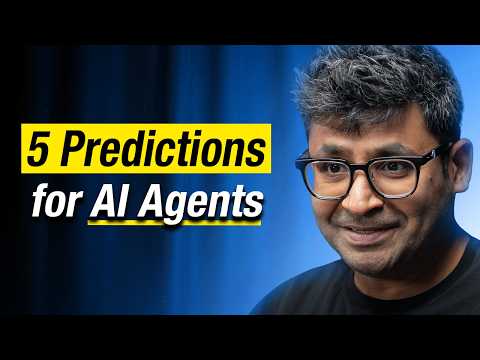
The Ads Business Model Will Die & Lessons from Working with Elon at Twitter | Parag Agrawal
Summarised with Bite · 12 min read
Parag Agrawal argues that agents will become the real users of the web, and that shift breaks both the technology stack and the business model of search. His core claim is simple but explosive: if agents use the web 1,000 times more than humans, search has to become radically cheaper, faster, and more incentive-aligned, or the open web, ads economy, and even software interfaces themselves start to crack.
0:00 – 16:19
Why agent search is not just bigger search, but a different species
The conversation opens with a blunt thesis that feels bigger than a startup pitch: agents will use the web "thousandx more than humans." That one sentence is doing almost all the work. Parag says that if scale jumps by three orders of magnitude, the current stack simply does not survive. Human search was built for short keyword queries, a half-second wait, and "10 blue links." Agents are different on every axis. They ask in full sentences, sometimes need answers in 100 milliseconds for voice, and other times can wait several seconds if they are a background worker trying to be thorough. That creates a strange new optimization problem. Search is no longer about showing links to eyeballs. It is about taking a web with trillions of documents and compressing it down to roughly a thousand tokens a model should actually see. Parag explains it as an allocation game: spend compute in search so you save more expensive compute in the model. If the downstream model is cheap, like his example of "Luna," you can afford to let more noise through. If the downstream model is expensive, like "Fable," you should do much more work upstream so you do not waste money and time on bad context. A surprising angle here is that smarter models do not eliminate search. Parag separates reasoning from memory. Models can often recall big, popular facts, but they are still "lossy compression," not perfect databases. They learn patterns, not every detail. So even if frontier models keep getting better, web search remains essential for long-tail facts, fresh information, and high-stakes tasks. At the same time, he thinks the model world will split in two directions: frontier systems get bigger and more capable, while smaller models keep reaching any fixed quality bar more cheaply every six months. That means the useful range of model sizes gets wider, not narrower, and search has to adapt to all of them.
3 more sections in the app
- 16:25 – 31:19The hidden market Parag thinks is coming: data payments, not ad clicks
- 31:52 – 50:17The pricing mistake in web search, and the shift from pull to push
- 50:49 – 1:08:38Powerful agents, weak guardrails, and what Parag learned from Elon
Summarised by Bite, an AI YouTube video summarizer that also works as a podcast summarizer.