Megaprojects
The $3.5 Billion Laser That Might Change Energy Forever
Summarised with Bite · 20 min read
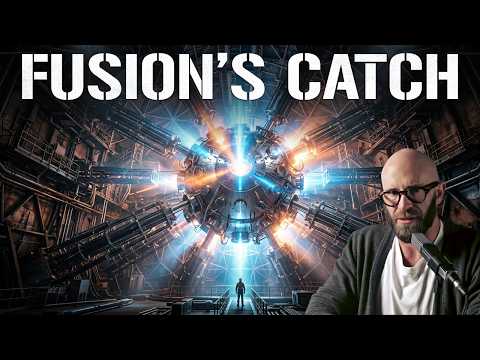
On December 5th, 2022, a $3.5 billion laser facility in California squeezed hydrogen fuel so hard it became hotter than the sun's core and produced 50% more energy than it took to trigger—crossing a threshold physicists chased for 60 years. But this wasn't about solving the energy crisis; it was about simulating nuclear warheads without detonating them underground, and the road from budget crisis to scientific proof reveals why breakthrough physics and useful technology are very different things.
0:00 – 2:00
The Moment Everything Changed
Picture 192 laser beams converging on a target smaller than a peppercorn. Inside a building covering three football fields, those beams fired into a tiny gold cylinder, heating it so violently that X-rays crushed a hydrogen capsule at its center to 100 times the density of lead and temperatures hotter than the sun's core. In a few billionths of a second, fusion reactions released 3.15 megajoules of energy—about 50% more than the 2.05 megajoules the lasers delivered. That December 5th, 2022 shot at the National Ignition Facility wasn't just another experiment. It was the first time any laboratory on Earth had achieved controlled fusion ignition, where the energy out exceeds the energy in. Secretary of Energy Jennifer Granholm compared it to the Wright Brothers at Kitty Hawk: proof that something long theorized was physically real. But just like that first flight didn't build an airline, NIF didn't solve fusion power. The facility still drew hundreds of megajoules from the electrical grid to charge the capacitors powering those lasers, making the overall wall-plug efficiency around 1% or less. Each shot cost between half a million and a million dollars and could fire maybe once a day. A fusion power plant would need to fire several times per second and produce gains 10 to 100 times higher. What NIF proved was physics. What it didn't prove was engineering, economics, or scalability—and that distinction matters when understanding what this $3.5 billion building actually accomplished.
5 more sections in the app
- 1:00 – 5:11Why America Built a Star Machine for Bombs, Not Power
- 6:12 – 9:52How You Actually Build a Star in a Lab
- 12:30 – 15:05The Budget Disaster That Nearly Killed Everything
- 15:37 – 19:43A Decade of Falling Just Short
- 23:01 – 25:57What Ignition Actually Means (and Doesn't)
Summarised by Bite, an AI YouTube video summarizer that also works as a podcast summarizer.