TED
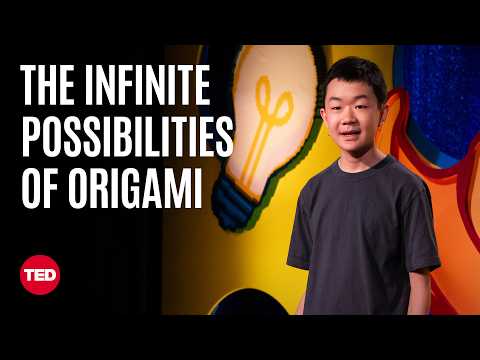
Origami, the Ancient Art Form Solving Modern Problems | Miles Wu | TED
Summarised with Bite · 10 min read
A 14-year-old origami enthusiast shows how paper folding can be much more than a hobby. In just a few minutes, Miles Wu moves from making ninja stars and charity pigeons to using the Miura-ori fold to test a serious engineering question: how to build lighter, stronger deployable shelters for people displaced by disasters.
0:08 – 1:45
From classroom mischief to seeing possibility in scrap paper
A worksheet turns into a ninja star, a sample cup at Trader Joe's becomes a crane, and a super-long CVS receipt somehow ends up as a centipede. That is the world Miles Wu invites the audience into right away, not as a polished science story, but as a kid's instinctive habit of refusing to see paper as just paper. At 14, living in New York City and juggling ninth grade homework and after-school activities, he describes origami as the thing he is always doing. Give him any scrap, and he will try to turn "nothing" into something. That opening matters because it explains the deeper engine behind the talk. Origami is not presented as a museum art form or a niche craft. For Miles, it is a training ground for imagination. He says he started folding more than seven years earlier, first making ornaments for his family's tiny Christmas tree, then getting in trouble for converting school papers into "academic weapons," a joke that lands because it captures a real truth. The same impulse that annoys teachers in one setting becomes the spark for creativity in another. He gives a few quick examples that make the abstract idea memorable. A newspaper becomes a lizard. A disposable cup becomes a crane. Those transformations are small, but they reveal the core lesson he has learned from origami: creativity often begins by looking at ordinary material and asking what else it could be. That is the unexpected angle of the talk. Paper seems flimsy, cheap, almost disposable. Yet in his hands, it becomes a way of thinking. The audience is left with a useful question that drives the rest of the talk: if a scrap of paper can become art, what else could folding unlock when the stakes are much higher than making a clever animal in a checkout line?
3 more sections in the app
- 1:45 – 2:47How folding birds turned a humble hobby into community help
- 2:47 – 4:20The fold that traveled from space to disaster shelters
- 4:20 – 5:55What 250 hours of lifting taught him about strength
Summarised by Bite, an AI YouTube video summarizer that also works as a podcast summarizer.