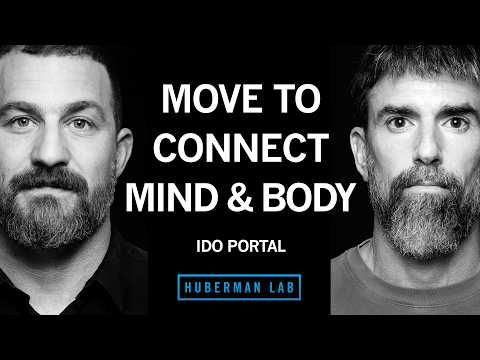
Andrew Huberman
Movement Practice to Strengthen Your Mind-Body Connection | Ido Portal
Summarised with Bite · 17 min read
This conversation is really about a hidden skill most people never train: how to notice and reshape the tiny transitions between body, attention, emotion, and action. Ido Portal argues that discipline matters, but if you lean on it too hard you become dependent on force, while play, softness, and what he calls exposing the will can change you more deeply and more sustainably.
3:38 – 13:34
Catching the invisible moments between sleep, grief, and waking life
The discussion opens in a strange place, half dream and half laboratory. Ido says that most people experience states like sleep and wakefulness as a simple on off switch, but with practice the border becomes textured. He describes being able to stabilize those fragile in between moments, the liminal territory where "it becomes a slow-mo journey" and you can "pause" inside the transition rather than getting dragged through it. That matters because, in his view, transition states are openings. They loosen the rigid filters and models through which we normally experience reality. He frames sleep as a daily chance to reset those rigid schemas. Instead of seeing sleep as just recovery, he describes a "waking sleep" and a way of taking "a sharp left just before" falling fully asleep. In that softened state, the normal protective membranes around thoughts and emotions can loosen, allowing recalibration. Huberman connects this to a personal story from 2014, after his graduate adviser died. Someone suggested he wake between 3:00 and 4:00 a.m. specifically to grieve. He expected it to be terrible, but found that crying between "3:00 am and 5:00 am" gave grief a designated space and seemed to work. Ido’s reaction is immediate: "That’s the point." When defenses are lower, buried material can finally move. From there, the conversation shifts to a surprising claim. Ido says that today people overvalue intensity. They reach for extreme tools and dramatic interventions, but often what changes a person is not a huge event, it is "a repeating mellow event, gentle event." That becomes a recurring theme of the episode. He applies it to prayer, meditation, and micro-practices. Long retreats and many-hour sits can be useful, he says, but they can also make people dependent on special conditions. His goal is not to become good at sitting, it is to carry the state into ordinary life. That leads to one of his most practical suggestions. Instead of walking away from a hard problem to distract yourself, walk while deliberately holding the problem in mind. The rule is simple: you are only at fault if you notice you’ve drifted and do not return. It is a different image of meditation, not blankness, but sustained contact. Throughout this opening section, the unexpected angle is that healing and insight may not come from escaping discomfort, but from learning to stay present inside transitions that most people skip over.
4 more sections in the app
- 24:03 – 47:08Discipline as scaffolding, play as fuel, and the handstand wall metaphor
- 1:01:16 – 1:26:38Why resolution matters more than fitness, and how modern life makes us coarse
- 1:43:38 – 2:07:05Training ambiguity, multistability, and the art of seeing two things at once
- 2:35:23 – 2:57:43Air sense, skateboarding, fighting, and what real movement looks like under chaos
Summarised by Bite, an AI YouTube video summarizer that also works as a podcast summarizer.