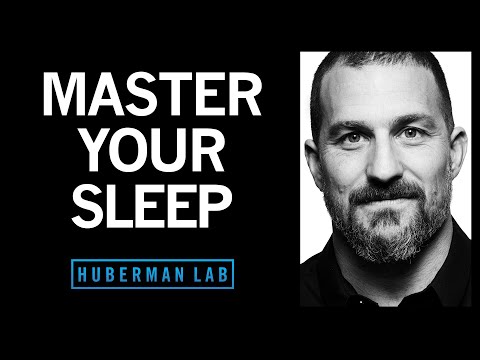
Andrew Huberman
Master Your Sleep & Be More Alert When Awake
Summarised with Bite · 14 min read
This episode is a practical map for controlling sleep by controlling the biology that controls it. Andrew Huberman explains that sleep is not mainly about willpower, it is about two forces, adenosine and the circadian clock, and the most powerful lever most people ignore is when light hits the eyes. If you understand that one mechanism and pair it with a few calming practices, you can fall asleep more easily, feel more alert when awake, and stop fighting your own nervous system.
5:38 – 12:30
The two invisible forces that decide when you crash
Huberman starts with a simple but powerful claim: sleep and wakefulness are not separate topics, they are tethered. The way you spend your day determines how easily you fall asleep, whether you stay asleep, and how you feel the next morning. Then he introduces the first hidden driver, adenosine. Think of it like sleep hunger. The longer you stay awake, the more adenosine builds up in the brain and body, and the stronger the pressure to sleep becomes. He makes the idea concrete through caffeine. Caffeine works because it blocks adenosine receptors. His analogy is memorable: caffeine parks in the receptor “slot,” so adenosine cannot park there. That is why you feel more alert after coffee, not because caffeine creates energy out of nowhere, but because it temporarily blocks the sleepy signal. When caffeine wears off, adenosine can bind again, sometimes with what he describes as even greater “affinity,” and that is the crash. What makes this section useful is that he refuses to give a fake universal rule. He says some people can drink caffeine at 4:00 or 5:00 p.m. and still sleep fine, while others cannot have any past 11:00 a.m. without wrecking sleep. The reason is variation in adenosine receptors and tolerance. His recommendation is not to moralize caffeine, but to test your own response experimentally and safely. Then he introduces the second force, the circadian system. If adenosine is the pressure that builds with time awake, the circadian clock is the timing system that says when your body should feel awake or sleepy within a roughly 24 hour cycle. This is why pulling an all nighter feels strange: even though adenosine keeps rising, morning can bring a burst of alertness because the circadian system is pushing in the opposite direction. That moment, when someone should be exhausted but suddenly feels more awake at dawn, becomes his proof that sleep is governed by at least two systems, not one.
4 more sections in the app
- 12:30 – 30:31Why morning light acts like a master reset button
- 19:17 – 1:19:36Supplements, melatonin skepticism, and the order that matters most
- 30:31 – 55:05The evening trap: how modern light delays sleep and drags mood down
- 1:00:54 – 1:11:17You cannot force sleep, so train the body to help the mind
Summarised by Bite, an AI YouTube video summarizer that also works as a podcast summarizer.