Jeremy Ethier
It's Weird, But It Re-Builds Your Tendons In 30 Days
Summarised with Bite · 9 min read
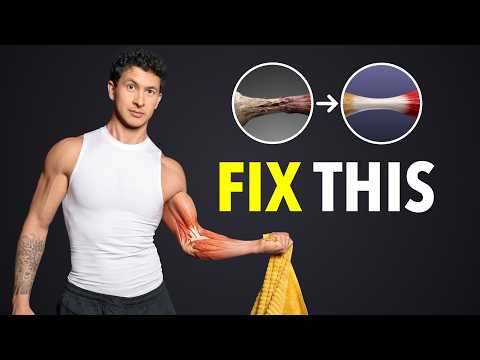
This video argues that recurring joint pain is often a tendon problem, not a muscle or bone problem, and that the standard advice to just rest usually fails. The big payoff is practical: it explains the two training mistakes that beat up tendons, then shows a simple isometric protocol that can reduce pain fast and help rebuild tendon strength over the next 4 to 8 weeks.
0:02 – 4:08
Why your joints keep complaining, and why rest backfires
It opens with a blunt reframe: squeaky, creaky joints are not just the price of training. The real culprit, he says, is often the tendon, the cable-like tissue that connects muscle to bone and has to survive enormous force every time you curl, press, jump, or swing. Coach Q Wiley gives the image that makes this click. When you jump off a couple of stairs and land on both feet, you do not want your muscle taking all the load. The tendon stretches quickly for a short moment, acting like a shock absorber so the muscle does not have to lengthen as violently. That is the unexpected angle of the whole video. Most people train as if building bigger muscles automatically protects everything else. But Dr. Keith Baar explains that tendons do not like what muscles like. The loading that is great for muscle or your heart is not automatically what optimizes tendon strength. If your muscles improve faster than your tendons, you create a mismatch, and that mismatch is what so often turns into pain. He puts a number on it from pro sports: 70% of their injuries are related to the tendon, or the muscle attached to it not being perfectly aligned. The video makes this memorable with a harsh example. In 1990s baseball, athletes using anabolic steroids could build muscle so quickly that the tendon became the weak link. Performance shot up, then, as he says, "bang," the tendon tore. You do not need steroids for the same pattern, though. Even everyday warning signs matter. A noisy shoulder click can happen because a tendon becomes a little "fatter," then has to slide through a narrow space and starts popping or rolling. Then comes the part that goes against instinct: one of the worst responses to tendon pain is complete rest. Rest may calm pain because nothing is provoking the tissue, but it does not solve the underlying weakness. The healthy parts of the tendon can get weaker while the damaged area never properly rebuilds, so the pain returns the moment training comes back. That is why old little injuries often resurface later, especially in people who were very active for years and then hit their 40s with persistent musculoskeletal pain.
2 more sections in the app
- 4:08 – 6:12The two mistakes that quietly damage tendons
- 6:12 – 10:22The 30-second holds that can calm pain and rebuild tissue
Summarised by Bite, an AI YouTube video summarizer that also works as a podcast summarizer.