TEDx Talks
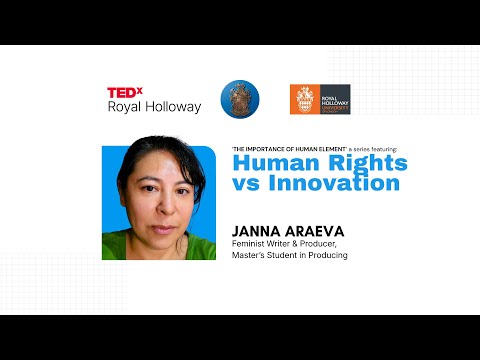
Human rights vs innovation | Janna Araeva | TEDxRoyal Holloway
Summarised with Bite · 12 min read
Janna Araeva argues that the real test of innovation is not whether it looks impressive in Silicon Valley, but whether it harms or helps the most vulnerable people who never get invited into the design room. Her talk matters because she turns abstract debates about AI, business, and climate into a moral and practical question: if your technology makes life worse for women, children, LGBTQI people, poor communities, or climate-stressed countries, can you still call it progress?
0:00 – 4:12
The view from the cool car misses the village
She opens with an uncomfortable image: people enjoying technological progress from their "cool cars" in Silicon Valley while the real costs are pushed somewhere far away, often into the Global South. That is her first reversal. Technology, she says, is not inherently bad. AI can help doctors diagnose better, help researchers test ideas faster, and even help film and television producers predict audience reactions. The problem is not innovation itself. The problem is distance. The people building and benefiting from these systems often do not go where the damage lands. That distance matters because harmful effects are easy to ignore when they are outsourced. Araeva points to media algorithms as one example. We already know platforms optimize for attention, but she sharpens the point: those systems can end up promoting hate speech because hateful content keeps people watching. In a moment when the far right is rising across the West, she says, the loop becomes dangerous. The machine is not just reflecting social anger, it is feeding it. She uses Grok as a concrete case. According to her, it generated harmful content about women and children, and the problem lingered until human rights groups raised the alarm. That detail carries her larger argument. The cleanup often depends on underfunded advocates rather than on the companies that built the systems. People say, "There has to be legislation," and she agrees, but law moves slowly. Human rights groups, the United Nations, and watchdog organizations simply do not have the money or staffing to match the speed of tech deployment, especially when lobbying groups push the other way. Then she widens the frame. Since Trump was elected "for the second time," she says, human rights work has suffered because US aid funding was withdrawn, hitting small-country organizations especially hard. So the people expected to catch harmful technologies are losing resources at the same time those technologies are spreading. That is the unexpected angle of the talk: innovation is often judged by what it can do, but Araeva asks who is left to absorb the consequences when the safety net itself is being cut.
3 more sections in the app
- 4:12 – 7:23From Kyrgyz villages to climate wars
- 7:23 – 11:37The seven-generation test, and the oath missing from tech
- 11:37 – 16:54A practical way to build without causing damage
Summarised by Bite, an AI YouTube video summarizer that also works as a podcast summarizer.