CrashCourse
How Water Shapes the Land: Crash Course Geology #9
Summarised with Bite · 11 min read
This episode uses one deceptively simple idea, water, to explain some of Earth’s strangest landscapes, from caves and hoodoos to the giant scars of Washington’s Channeled Scablands. What makes it worth caring about is the twist: water is not just a slow sculptor working over millions of years, it can also rewrite a landscape in days, and understanding that helps explain both natural beauty and real hazards like floods, sinkholes, and landslides.
0:00 – 3:09
The ordinary liquid behind bizarre landscapes
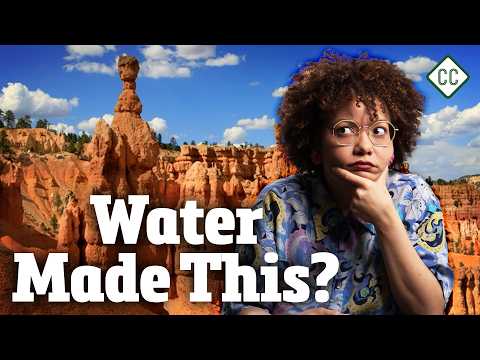
A short drive east of Seattle lands you in a place that looks almost mistaken: a giant gouge like a dried-up super-waterfall, barren rock beside fertile hills, and channel networks that look uncannily brain-like. The episode opens there for a reason. The question is almost irresistible: what could possibly carve something this oversized and this strange? Sage’s answer is wonderfully anticlimactic and huge at the same time: water. From there, the video zooms out to the daily machinery that makes water so geologically powerful. The water cycle constantly moves water among oceans, glaciers, lakes, and rivers, powered by solar energy and gravity. That movement gives water many chances to reshape rock. One path is chemical weathering, where water helps trigger reactions that transform or destroy minerals. Sage makes this memorable with karst landscapes, places made mostly of carbonate rock that dissolves in weak acid. Rain is slightly acidic, so over thousands of years it can eat into the ground “swiss-cheese style,” eventually producing cave systems like the ones shown in Slovenia. The other path is physical weathering, where water acts less like chemistry and more like a wedge and a hammer. It can crash against rock with force, or seep into cracks and freeze. When water turns to ice, it expands, prying rock apart, as in the limestone of England’s North Pennine region. The important distinction comes next: weathering breaks rock down, while erosion moves the broken material away. That pairing, breakdown plus transport, is what turns water from a background ingredient into a landscape designer. Sage then uses Bryce Canyon to show the two processes working together. Hard rock caps protect softer layers below, rain and snowmelt carve steep walls, freeze-thaw cycles open cracks into windows, and collapsing roofs leave behind the narrow towers we call hoodoos, tent rocks, or fairy chimneys. Chemical weathering rounds them into those strange bulb-like shapes. It is a nice example of the episode’s deeper point: landscapes that look fantastical are often the result of simple processes repeated relentlessly.
3 more sections in the app
- 3:09 – 5:51How rivers redraw maps and groundwater hollows the world beneath us
- 6:21 – 7:59The flood theory that sounded absurd until it explained everything
- 7:59 – 9:32Why water’s geology matters to people living on the land today
Summarised by Bite, an AI YouTube video summarizer that also works as a podcast summarizer.