Andrew Huberman
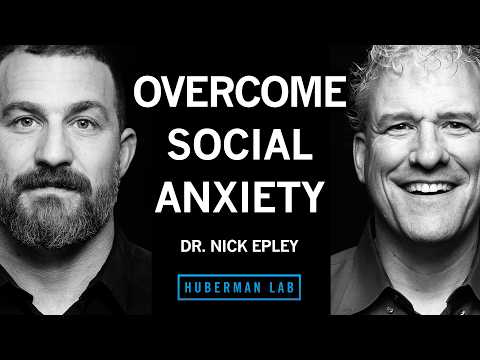
How to Overcome Social Anxiety | Dr. Nick Epley
Summarised with Bite · 14 min read
Behavioral scientist Dr. Nick Epley reveals a counterintuitive truth: our fears about social connection are wildly misplaced. Research across 30,000+ participants shows we consistently underestimate how positively strangers respond when we reach out, whether striking up a conversation on a train or asking for help. These small, seemingly trivial interactions aren't social fluff—they're foundational to mental and physical health, and we're leaving them on the table out of unfounded pessimism.
0:00 – 1:30
The Cure for Social Anxiety Isn't What You Think
Social anxiety dissolves not by dulling your fear, but by correcting a mistaken belief. When psychologists tried to treat social anxiety with simulated practice—giving pretend speeches, imagining conversations—it failed. The breakthrough came when researchers realized exposure had to be real. Send someone terrified of rejection into the world to actually ask strangers for help, and they discover their fear was baseless. Acceptance rates are far higher than predicted. This isn't about building thick skin through repeated pain. It's about discovering other people are kinder than you thought. Gia Giang documented this perfectly in his 100-day rejection challenge. He set out to get rejected daily—asking to borrow $100 from security guards, requesting Olympic ring-shaped donuts from Krispy Kreme, proposing to co-pilot a plane with zero experience. He expected harsh refusals. Instead, Jackie at Krispy Kreme spent 15 minutes crafting his donut rings. Southwest Airlines let him address an entire plane. A stranger let him play soccer in their backyard. Out of 106 requests, he was accepted 51 times and rejected only 48, with negativity appearing in just seven interactions. The lesson holds across research: we wildly overestimate how many people we'll need to ask before someone agrees. Frank Flynn and Vanessa Bohns call this the "underestimation of compliance effect." People not only agree more often than predicted—they feel better about helping than you'd guess. When you ask someone to take your photo at the beach, you think you're being a burden. They're actually happier for the chance to be kind.
6 more sections in the app
- 18:27 – 24:30Your Voice Reveals You Have a Mind
- 31:11 – 38:30The Leaky Tire Theory of Happiness
- 41:00 – 48:00Why Introverts Should Act Extroverted Anyway
- 50:24 – 56:00What Adoption Taught About the Role You Play
- 1:16:00 – 1:24:00When Lindsay Became a Blessing
- 1:24:06 – 1:30:18The Elk Hunt That Became a Community
Summarised by Bite, an AI YouTube video summarizer that also works as a podcast summarizer.