TEDx Talks
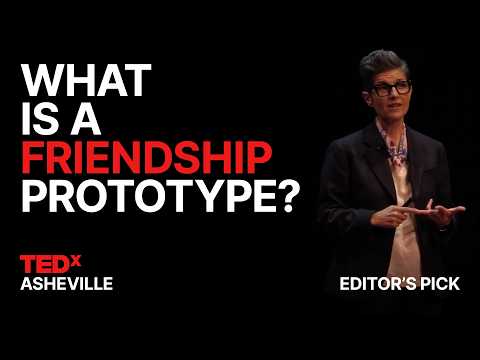
How to make new friends (without the social anxiety) | Jenn Maer | TEDxAsheville
Summarised with Bite · 13 min read
Jenn Maer turns a painful adult problem, moving to a new city and realizing your real support system lives 2,500 miles away, into a practical method for making friends without the usual social paralysis. Her big idea is surprisingly simple: stop waiting for friendship to happen organically, and start designing small, low-pressure experiments that give connection a structure to grow inside.
0:07 – 3:47
When loneliness stops feeling dramatic and starts feeling physical
She opens with a scene almost every adult secretly dreads: you move to a new city thinking, "Yay, new everything," and then the punchline lands, "Oh, like new everything." A new dentist, a new dog sitter, and hardest of all, new friends. Jenn Maer had moved from Oakland to Asheville during the pandemic, which made the usual process of finding people even stranger and thinner. Eventually she found the practical pieces of a life, but not "my people," the front porch people, the "Oh my god, what is this rash?" people, the people you call when your dog dies and you cannot get out of bed. Those people were still in California, 2,500 miles away. That distance mattered more than simple inconvenience. She says there were times when the loneliness "felt like it might kill me," and then sharply undercuts any temptation to dismiss that as melodrama. In 2023, the US Surgeon General's report on the epidemic of loneliness made clear that poor social connection has real physical consequences. Her point is not just that loneliness hurts. It is that modern adult life is built in ways that quietly produce it. As kids, friendship came with infrastructure. You showed up at school, and the other little kids were simply there at recess. As adults, many people work from home, loved ones are scattered across the country, people move every few years, and phones soak up the time that used to become casual connection. Then she drops the numbers that make the problem feel mechanical rather than personal failure. Research shows it takes about 100 hours to make a friend and 200 or more hours to make an intimate friend. At the same time, we lose about 50 percent of our friends every 7 years. People move, fall out, die. Her unexpected angle is brutal and clarifying: even if you think you already have enough friends, "do the math." Friendship is not a one-time achievement. It is something that must be replenished, because life is constantly draining the pool.
4 more sections in the app
- 3:47 – 5:52Why standing in the corner never worked
- 5:52 – 10:28The lunch where friendship became an experiment
- 10:28 – 13:03A silly name, tater tots, and the structure that made care real
- 13:34 – 15:07The real goal is not a perfect plan, it is a container