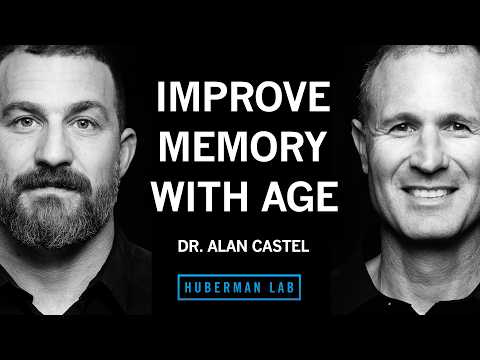
Andrew Huberman
How to Improve Your Memory & Cognitive Function at Any Age | Dr. Alan Castel
Summarised with Bite · 22 min read
This episode is a deep tour of how memory actually works, why mistakes and struggle improve learning, and how aging changes memory in ways that are more hopeful than most people assume. Alan Castel argues that staying sharp is not mainly about hoarding facts, but about curiosity, selective attention, movement, balance, social connection, and even your beliefs about aging itself.
2:36 – 10:17
Why failure teaches memory better than repetition
A kid in a school play stands up to deliver one memorized line and flips it inside out: instead of warning that a cyclone is coming and to get into the cellar, he blurts, "there's a seller on the way. hurry and get into the cyclone." That childhood mistake became one of Alan Castel's first clues that memory is not a camera. It is reconstructive, fragile, and strangely confident even when wrong. From there, he draws a sharp line between memorizing and understanding. As a student, he could nearly recite the periodic table using little rhymes and tricks, but later realized he did not really understand chemistry. That contrast sets up one of the episode's central ideas: shallow encoding, like labels and jingles, can get you through a quiz, but deeper learning comes from meaning, relationships, and interaction. Huberman suggests verbs rather than labels, not just what something is called, but what it does, how it behaves, what it reacts with. Castel agrees and ties this to classic "levels of processing" research. Then comes the memorable example that makes the idea stick. People have seen the Apple logo thousands of times, yet when asked to draw it, many cannot say whether the bite is on the left or right, or whether there is a stem or leaf. Mere exposure did not do the job. What helps is trying and failing first. Draw it from memory, struggle, wonder, get it wrong, then look again. That failed retrieval changes attention. Suddenly the features matter. This is the unexpected angle of the whole conversation: good learning often feels worse in the moment. Teachers and students often want learning to feel smooth, but Castel points to desirable difficulty, the idea that challenge, confusion, and corrective feedback create stronger memory than easy review. He compares it to piano practice and to a simple safety study where people remembered a fire extinguisher's location better when they had to get up and find it themselves rather than merely being told where it was. Seeing is not noticing. Repetition is not learning. The gap between what you think you know and what you can actually retrieve is where memory gets built.
7 more sections in the app
- 13:52 – 21:07Curiosity, discomfort, and the hidden engine of learning
- 21:38 – 34:02Why emotional memories feel true, even when they are wrong
- 35:04 – 47:26Everyday memory, autopilot, and how forgetting can save you
- 48:34 – 56:49Why older adults repeat stories, and what really predicts aging well
- 1:00:28 – 1:22:23Midlife misery, old age myths, and what superagers actually do
- 1:24:00 – 1:40:28Love, balance, and the psychology of successful aging
- 1:41:40 – 2:25:56Curiosity, resilience, scams, and the wisdom of selective memory
Summarised by Bite, an AI YouTube video summarizer that also works as a podcast summarizer.