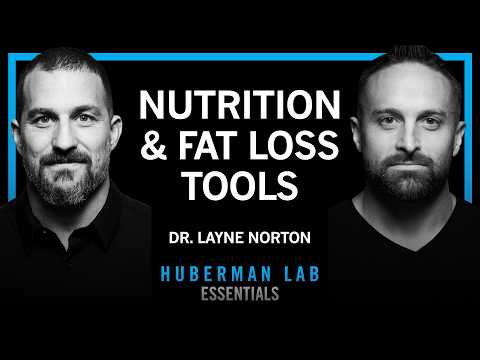
Andrew Huberman
Essentials: The Science of Eating for Health, Fat Loss & Lean Muscle | Dr. Layne Norton
Summarised with Bite · 16 min read
This conversation is really about stripping nutrition down to the levers that actually move body composition and health: energy balance, protein, food processing, and a few high-signal supplements. Layne Norton’s big message is surprisingly unglamorous but useful: the body obeys calorie balance, yet the way different foods affect hunger, muscle retention, and adherence is what determines whether you can live that math in real life.
0:00 – 7:21
Calories are simple on paper, messy in real life
A food label says one thing, your body does another, and that gap is where most nutrition confusion begins. Layne Norton starts with the part people love to dismiss as "too simplistic," calories in versus calories out, and then immediately makes it more interesting by showing how complicated the machinery underneath really is. A calorie is just a unit of energy, but once food enters the body, it has to be digested, absorbed, and converted into ATP, the molecule your cells actually spend. Protein can become amino acids for tissue repair, or glucose through gluconeogenesis. Fat gets chopped down through beta oxidation. Carbohydrate is more direct. The principle is simple, but the path is anything but. Then he turns the camera toward the hidden noise in the system. Food labels can be off by up to 20%, which is a startling number because many people treat them like gospel. Even that is not the whole story, because there is a difference between energy in food and metabolizable energy, meaning what your body can actually extract. Insoluble fiber can lock calories inside plant structures so digestive enzymes never fully access them. Some people may even pull more energy from fiber than others because of differences in their gut microbiome. Norton’s unexpected angle is that this messiness does not make tracking useless. If the error is consistent, your own body weight trend eventually teaches you the truth. On the energy out side, he breaks total daily expenditure into buckets. Resting metabolic rate is the giant one, typically 50 to 70% of daily burn. The thermic effect of food is smaller, about 5 to 10%, but crucial because it explains why 100 calories of protein do not behave like 100 calories of fat inside the body. Fat has a thermic effect of about 0 to 3%, carbohydrate about 5 to 10%, and protein about 20 to 30%. So 100 calories of protein might net only 70 to 80. That is why Norton says the phrase "not all calories are created equal" is wrong in one sense and right in another. A calorie is a calorie, just like a second is a second. But calorie sources change hunger and energy expenditure, which changes outcomes. He finishes this section with one of the most practical points in the episode: non-exercise activity thermogenesis, or NEAT, can swing by hundreds of calories and in some cases close to a thousand per day. Fidgeting, pacing, hand movements, all the little background motion of being alive, can quietly dominate the weight-loss story more than people realize.
4 more sections in the app
- 7:21 – 9:27Why diets fail after they work
- 9:27 – 17:42Protein is the big lever, but total intake beats perfection
- 17:42 – 26:39Processed food, sweeteners, and seed oils, the hierarchy matters more than the headline
- 26:39 – 31:44Creatine is useful, but hard training still wins
Summarised by Bite, an AI YouTube video summarizer that also works as a podcast summarizer.