Andrew Huberman
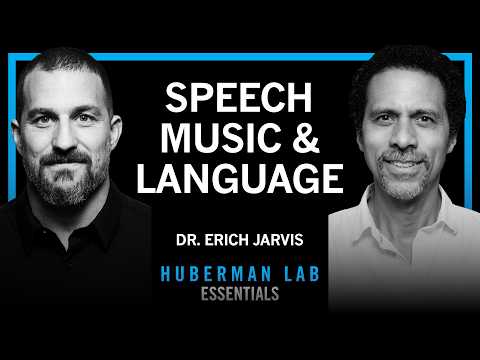
Essentials: The Neuroscience of Speech, Language & Music | Dr. Erich Jarvis
Summarised with Bite · 11 min read
Dr. Erich Jarvis reveals how speech and language aren't separate modules in the brain—they're intertwined motor circuits evolved from body movement pathways. Through groundbreaking comparisons between humans, songbirds, and parrots, he shows that the same genes controlling our ability to speak also enable zebra finches to learn their songs, and that keeping your brain sharp might have less to do with crossword puzzles and more to do with dancing.
0:00 – 5:06
The Speech-Language Myth: Why Your Brain Doesn't Have a 'Language Module'
Picture two pathways in your brain: one controlling your larynx and jaw to produce sound, another interpreting what you hear. For decades, neuroscientists assumed a separate 'language module' sat between them, orchestrating the whole show like a conductor. Dr. Jarvis dismantles this idea entirely. "There is no good evidence for a separate language module," he explains. Instead, the speech production pathway itself contains all the complex algorithms for spoken language, while the auditory pathway handles comprehension—no middleman required. What makes humans special isn't some unique language organ—it's that our forebrain learned to hijack the brainstem circuits controlling our voice box. Dogs can understand hundreds of words ("sit," "stay," "get the ball") because auditory comprehension is widespread in the animal kingdom. Great apes can learn thousands of signs. But neither can speak a single word because they lack the specialized forebrain-to-larynx circuitry that humans share with only parrots, songbirds, and hummingbirds. The famous gorilla Koko understood sign language and could gesture fluently for 39 years but couldn't produce those sounds vocally. Her brain had the motor pathways for learned hand gestures but not for learned voice gestures. This distinction reshapes how we think about language evolution. When Jarvis gestures while talking on the phone where no one can see him, it's not random—hand gesture circuits sit directly adjacent to speech circuits in the brain. He argues speech pathways evolved out of body movement pathways, which explains why Italians, French, and English speakers each come with their own culturally learned gesture sets. Language isn't a cognitive abstraction floating above motor control; it's motor control that got incredibly sophisticated.
4 more sections in the app
- 5:06 – 17:24The Convergent Evolution Mystery: How Songbirds Cracked the Same Code as Humans
- 17:24 – 21:20Inside the Vocal Learning Brain: Genes That Turn Off to Let Speech Turn On
- 21:20 – 34:47The Critical Period Mystery: Why Children Learn Languages Adults Can't
- 23:07 – 35:20The Emotional Dimension: Music, Meaning, and the Left-Right Brain Split
Summarised by Bite, an AI YouTube video summarizer that also works as a podcast summarizer.