Andrew Huberman
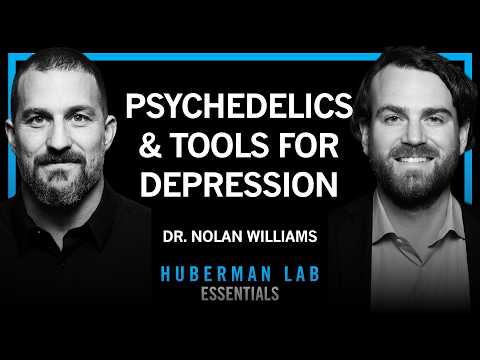
Essentials: Psychedelics & Neurostimulation for Brain Rewiring | Dr. Nolan Williams
Summarised with Bite · 9 min read
Dr. Nolan Williams, a Stanford psychiatrist pioneering rapid treatments for severe depression, reveals how brain stimulation and psychedelics work by fixing circuits, not chemical imbalances. In one conversation, he dismantles 60 years of psychiatric dogma while explaining why certain treatments can eliminate suicidal depression in five days, how ibogaine lets Special Forces soldiers forgive themselves, and why depression might be less like a broken brain and more like a heart arrhythmia you can reset.
0:00 – 7:18
Depression as a Heart Problem (Not Just a Mind Problem)
The American Heart Association recently added depression as the fourth major risk factor for coronary artery disease, right alongside hypertension, high cholesterol, and diabetes. This isn't metaphorical. Williams's lab uses transcranial magnetic stimulation (TMS) over the dorsolateral prefrontal cortex, the brain's control center, and can actually decelerate someone's heart rate in real time. The signal travels from that frontal region down through the anterior cingulate, insula, and amygdala, then into the nucleus tractus solitarius, and finally into the vagus nerve that connects to the heart. Do the same stimulation over visual cortex or motor cortex? Nothing happens. The connection is specific to this mood-regulating circuit. What makes this matter: depression both causes other illnesses and makes existing ones worse. Williams came to this realization after training in both neurology and psychiatry. In neurology, acute brain emergencies (strokes, seizures) have rapid interventions. In psychiatry, someone in a suicidal crisis typically gets the same oral antidepressants they've been taking for months, just in an inpatient setting. He wanted to engineer something faster, something that worked like acute neurology does. Patients have told him their therapists said they "weren't trying hard enough" in therapy. Then, after a five-day course of this accelerated TMS, they come back the next week and say they finally understand their therapy books. The metaphor Williams uses: in depression, the players are telling the coach what to do. TMS restores order so the coach (prefrontal cortex) can govern the players (deeper emotional regions). One patient, after remitting by Wednesday, drove to the beach Thursday night and sat completely present for an hour. He'd read about mindfulness for years but never experienced it until his brain's circuitry reset.
3 more sections in the app
- 7:18 – 13:17Why SSRIs Work (and Why the Chemical Imbalance Story Is Dead)
- 13:17 – 31:00How Psychedelics Rewire the Brain (Without Keeping You High)
- 31:00 – 36:31The Stanford Protocol That Crams Six Weeks Into Five Days
Summarised by Bite, an AI YouTube video summarizer that also works as a podcast summarizer.