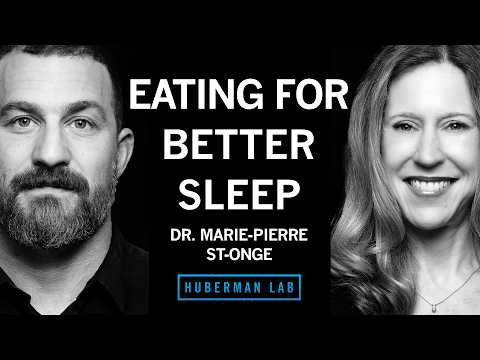
Andrew Huberman
Eating for Better Sleep & Foods that Improve Metabolic Health | Dr. Marie-Pierre St-Onge
Summarised with Bite · 12 min read
Dr. Marie-Pierre St-Onge reveals how sleep and food form a two-way street: poor sleep drives overeating (300+ calories/day), while what you eat—especially fiber versus saturated fat—shapes your sleep quality that same night. Her work shows that timing meals early in the day, choosing the right fats, and understanding sex-specific hunger signals can break the vicious cycle where bad sleep leads to worse eating, which leads to even worse sleep.
0:00 – 23:00
The Hidden Calorie Tax of Sleep Deprivation
Picture this: you sleep just four hours a night for five nights. When given free access to food on the sixth day, you eat 300 extra calories without thinking about it. That's what Dr. St-Onge found when she brought people into her lab and measured everything under controlled conditions. But here's where it gets interesting: the mechanism differs by sex. In men, ghrelin (the hunger hormone) spikes after short sleep. It's a direct biological shout to eat more. In women, GLP-1 (the satiety peptide that tells you to stop eating) drops instead. Same outcome, different pathways. When Dr. St-Onge first analyzed her data with men and women together, she saw no effect on ghrelin at all. That baffled her because prior studies had clearly shown sleep restriction increases ghrelin. Then she split the data by sex and it clicked: there was no effect in women, but a strong one in men. All those prior studies? They'd only enrolled men. Brain scans added another layer: reward centers light up more intensely for food after sleep loss, regardless of sex. So you're hit from multiple angles—hormones pushing you toward the fridge, and your brain finding that donut more irresistible than usual. Over six weeks of sleeping just six hours per night (a realistic scenario for many people), participants showed increased insulin resistance and higher blood pressure. The weight gain was modest but real: about half a kilogram in two weeks when people slept 5 hours versus 7.5 hours, without changing anything else. The takeaway isn't just that sleep matters. It's that even modest, sustained sleep loss—the kind you might rack up during exam season, a work deadline, or caring for a sick relative—recalibrates your appetite in ways that make overeating feel automatic, not like a failure of willpower.
4 more sections in the app
- 23:00 – 44:00What You Ate Today Shapes How You Sleep Tonight
- 44:00 – 1:16:00Timing Your Meals: The 10-Hour Window That Burns More Fat
- 1:16:00 – 1:30:00The Ginger Effect and Other Functional Foods That Boost Metabolism
- 1:30:00 – 1:48:00Industry Funding, Null Results, and the Real Story Behind Nutrition Science
Summarised by Bite, an AI YouTube video summarizer that also works as a podcast summarizer.