Jay Shetty Podcast
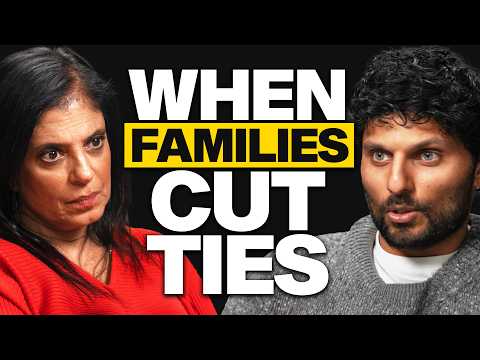
Dr. Ramani: How to Know if You Should Go No Contact With a Family Member
Summarised with Bite · 18 min read
This conversation is about one of the hardest questions in family life: when stepping back from a relative is self-protection, not cruelty. Dr. Ramani argues that no contact is usually not a rash decision at all, but the end point of years of failed repair, repeated harm, and self-abandonment, and she gives a practical framework for deciding what to do without romanticizing forgiveness or family loyalty.
0:32 – 7:09
When family stops feeling like family
The episode opens with a blunt line that cuts through a cultural taboo: "Not all families are good. Many families are harmful." That is the frame for everything that follows. Dr. Ramani defines no contact in the starkest possible way, "It's no more contact. It's no more digital contact. It's no more in-person contact." Then she adds the part that makes the idea land emotionally: it is "almost like the death of a relationship even while the people are living." Jay Shetty brings in a number that explains why this topic now feels everywhere, 27% of US adults reported being estranged from one or more family members, based on Cornell University's Family Estrangement and Reconciliation Project. But Dr. Ramani immediately complicates that number. Estrangement is heterogeneous, meaning not one clean category. Some people leave because there is "no safety here," because staying connected means "fully abandoning myself to remain in relationship with this person." Others use cutoff punitively, the emotional version of "I'll show you," which she illustrates with a sibling cutting you off because you would not loan them money. Those two cases may look the same from the outside, but psychologically they are worlds apart. Her real frustration is with the reflexive shame society throws at the person who leaves. The first response is often, "What's wrong with you?" instead of, what happened to make this feel necessary? She gives a haunting example of someone abused as a child whose family still minimizes or denies it. As a child, they were not protected. As an adult, they are now told their own history is negotiable. In that setting, no contact is not a tantrum. It is a final refusal to let the family erase reality. Dr. Ramani makes this concrete by sharing that she herself is actively navigating a no contact situation in her own family system, and says her process was "a 40-year process." That detail matters. It destroys the fantasy that people make this choice casually. In her clinical work, the people who go no contact for safety and healing usually spend "years and years and years" wrestling with guilt, disloyalty, and the fear that they are somehow bad. By the time they act, they have usually already tried everything else.
5 more sections in the app
- 7:11 – 14:55The real breaking point is not one event, it is self-abandonment
- 15:25 – 22:05How to test change, and why no contact often starts quietly
- 24:12 – 38:18The tiger's cage, smear campaigns, and the price of peace
- 50:08 – 1:12:38Family loyalty, soul distancing, and the myth of mandatory forgiveness
- 1:13:50 – 1:25:11The final tests: illness, weddings, money, and what should guide the choice