The Temporal Nomad
A Society Where Money Replaced Every Value | Max Horkheimer
Summarised with Bite · 14 min read
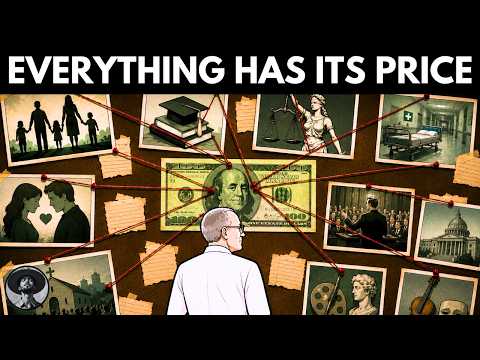
This video turns Max Horkheimer into a mirror for modern life. Its core claim is unsettling and memorable: money did not simply become important, it became the default judge of what counts as worthwhile because modern reason forgot how to ask what is good, just, or meaningful. If you have ever felt productive but oddly empty, entertained but not restored, or successful without knowing what the success is for, this video explains why.
0:10 – 14:19
The Heir Who Walked Away, and the Birth of a World Ruled by Calculation
It opens in the most ordinary place possible: a dark bedroom, a glowing phone, one last work message, a credit card bill in another tab, and that forbidden midnight question, what am I doing all this for? The video uses that tiny scene like a trapdoor. What looks like a private failure of discipline or meaning is recast as a historical outcome. Time has become currency, rest feels guilty, hobbies need to become side hustles, and even silence starts to feel like waste. The unsettling claim is that this is not your personal defect. It is a civilization speaking through your habits. That is why the biography matters. Max Horkheimer was not an outsider romanticizing poverty. He was born in 1895 near Stuttgart as the son of a wealthy textile industrialist, an heir whose life was already written: inherit the factory, multiply the wealth, continue the line. But on the factory floor he saw something that split his path in two. Workers were reduced to parts of a machine, and bosses were reduced to calculating machines. So he abandoned the inheritance, studied philosophy, psychology, and economics, and eventually became director of the Institute for Social Research in Frankfurt in 1930, the institution later known as the Frankfurt School. Exile sharpened his diagnosis. Forced out of Germany in 1933 because of his Jewish background and his ideas, he fled to the United States and found something almost more chilling than open repression. In America he saw a quieter domination, one that needed no soldiers because it lived inside consciousness itself. This becomes the setup for Eclipse of Reason. The video explains Horkheimer's central distinction with unusual clarity. Objective reason asks about ends: What is a good life? What is just? What deserves to be done? Instrumental reason asks only about means: What works? What is efficient? How do we get there fastest? The difference is made painfully concrete with a job offer. Objective reason asks whether the work is dignified and whether doing it daily would make you better. Instrumental reason asks how much it pays. The second question is necessary. Horkheimer's point is not that calculation is evil. It is that calculation was left alone after the older questions were laughed out of the room. Once science and positivism narrowed legitimate knowledge to what can be measured, values were demoted to private opinion. We learned to debate percentages with rigor and meaning with embarrassment. In that vacuum, one value fit perfectly: money. It is measurable, comparable, universal. It won not because it proved itself morally supreme, but because it spoke the only language modern reason still respected, numbers.
3 more sections in the app
- 14:19 – 24:08How Enlightenment Turned Into a Machine, and Why Entertainment Became Part of Work
- 24:08 – 33:56Manufactured Desires, Exhausted Selves, and Relationships Turned Into Assets
- 33:56 – 53:02Why Rebellion Gets Sold Back to You, and Horkheimer's Modest but Radical Way Out
Summarised by Bite, an AI YouTube video summarizer that also works as a podcast summarizer.