Horological Society of New York
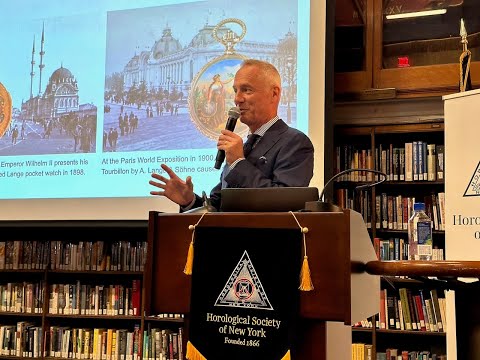
A. Lange & Söhne and Its Very Own Way of Watchmaking, by Wilhelm Schmid
Summarised with Bite · 10 min read
Wilhelm Schmid, CEO of A. Lange & Söhne, traces the brand's resurrection from Communist-era ruins to becoming one of watchmaking's most uncompromising houses. He reveals how a fragile gunsmith's son built an empire in 1815, why the company launched four new movements in 1994 when survival seemed impossible, and how design constraints—from hand-engraved balances to waterproof minute repeaters—force craftspeople to push boundaries even when it means assembling every watch twice.
7:38 – 13:06
The Gunsmith's Son Who Built an Empire in a Valley With No Future
In 1845, Ferdinand Adolph Lange was fragile, poor, and facing an impossible choice. His father was a gunsmith in post-war Europe—the last profession anyone needed. But Lange was determined. He convinced a Royal watchmaker named Gutkaes to adopt him and fund his education, then did something radical: he rejected the safe path of inheriting Gutkaes's established business to start his own in Glashütte, a dying mining town in Saxony's mountains. The silver ore was gone. Agriculture was hopeless in the valley terrain. There was nothing. Lange secured a government loan (which he repaid) and opened a watchmaker school with 15 students. His mission statement, from day one: build the world's best watches. Not competitive watches—the best. He succeeded. By the late 1800s, A. Lange & Söhne was making complications for Tsars, German emperors, and collectors worldwide. A pocket watch from the 1900 Paris World Exposition—stolen during Communist rule, auctioned in Zurich for 1.8 million Swiss francs in 1986—now sits in a Boston museum, maintained one final time before being permanently locked to preserve its originality. Then came 1948. The Communists expropriated everything. Walter Lange, Ferdinand's great-grandson, fled rather than work in uranium mines where survival averaged two years. The family name disappeared into a state conglomerate called GUB, producing cheap watches for Soviet markets. For 45 years, A. Lange & Söhne ceased to exist.
4 more sections in the app
- 13:06 – 20:10Four New Movements in 1994: The Gamble That Shouldn't Have Worked
- 57:02 – 1:02:48Why Every Watch Gets Assembled Twice (and What That Costs)
- 17:22 – 23:54The Watch Nobody Wanted: How Zeitwerk Became the Miracle
- 51:09 – 57:02The Hidden Cost of Beauty: Why Screws and Corners Define Limits
Summarised by Bite, an AI YouTube video summarizer that also works as a podcast summarizer.