PensionCraft
2008 Financial Crisis 2.0: Is It Already Happening?
Summarised with Bite · 11 min read
This video argues that a replay of 2008 is not here in the exact same form, but the conditions for a new kind of financial accident are quietly building. The key idea is simple: banks were forced to become safer after the crash, regulators are now easing those safeguards, and some of the risk has migrated into private credit and other shadowy parts of finance that are harder to see and harder to measure.
0:00 – 4:10
The run most people remember was not the real run
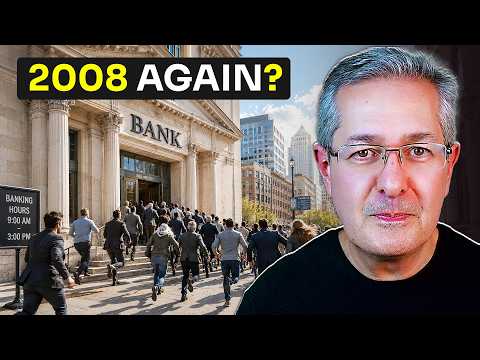
Picture the scenes outside Northern Rock in 2007: people literally lining up in the street to pull out savings, the sort of image Britain had not seen since 1866. The video starts by flipping that memory on its head. Those queues were not the first sign of trouble. They formed after the Bank of England had already stepped in. The real bank run had happened earlier, quietly, in the wholesale funding markets, where Northern Rock depended on other institutions for short term money. By the summer of 2007, only 23% of its funding came from retail savers. The rest was borrowed, and when that market froze on 9 August 2007, the bank was suddenly stranded. That mattered because Northern Rock had piled on extraordinary leverage. Its borrowing relative to equity rose from about 23 times in 1998 to 58 times by the middle of 2007 and over 86 times by the end of that year. At that level, even a small wobble can be fatal. The video makes the point with a useful contrast: the public saw frightened depositors, but the real structural weakness was hidden in how the bank funded itself. That is the larger lesson for the whole video. Financial crises rarely begin where the cameras are pointing. There is also an important human detail. Savers were not irrational. Deposit protection was much weaker then. In the UK, deposits were fully insured only up to 2,000 pounds, then just 90% of the next 33,000, leaving a maximum claim of 31,700 pounds. If you had more than that in Northern Rock, standing in line was not hysteria, it was self protection. From there, the video zooms out to 2008. A niche US subprime problem became a global shock. The Financial Crisis Inquiry Commission said the crisis was avoidable and followed more than 30 years of deregulation. The numbers explain why. Big five US investment banks were levered as high as 40 to one, meaning a drop of less than 3% in asset values could wipe them out. Financial sector debt ballooned from about $3 trillion to roughly $36 trillion. When the Reserve Primary Fund, something people treated almost like cash, broke the buck, more than $40 billion fled in just a few days. The system was not fragile by accident, it was designed that way by years of incentives that rewarded thin capital and huge balance sheets.
2 more sections in the app
- 4:10 – 11:56Why capital buffers exist, and why governments are trimming them again
- 11:56 – 20:17The risk did not disappear, it slipped into the shadows
Summarised by Bite, an AI YouTube video summarizer that also works as a podcast summarizer.